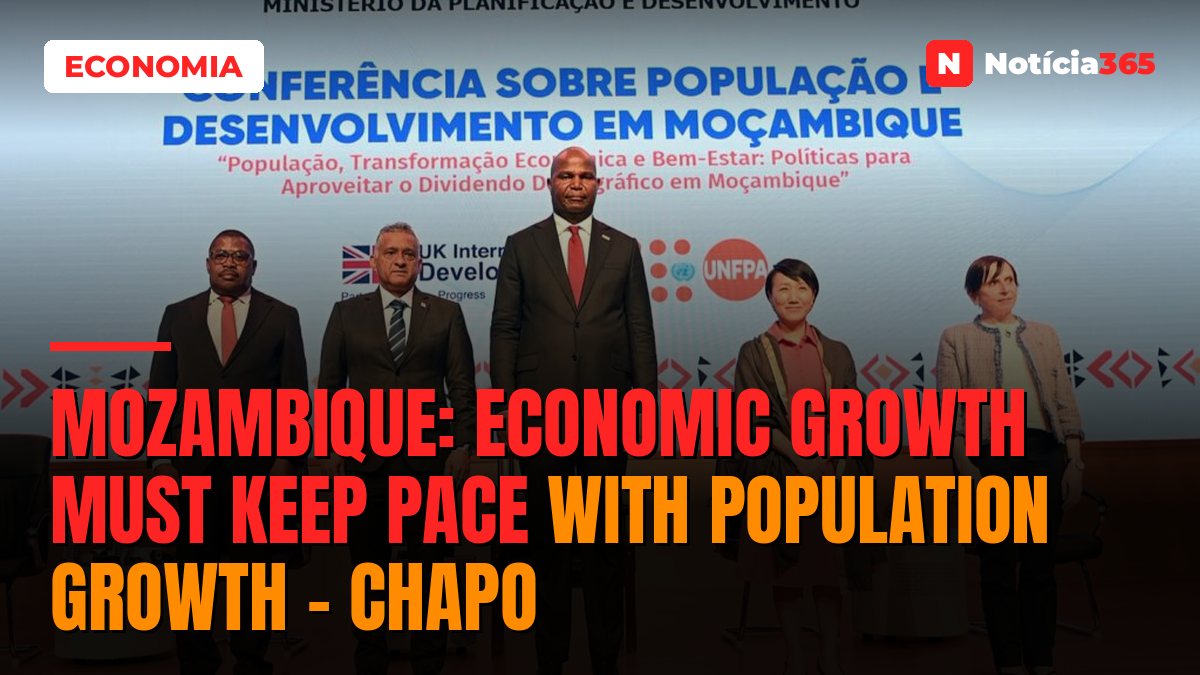
Mozambican President Daniel Chapo has reaffirmed that the country’s economic growth must ensure jobs and better living conditions in order to keep pace with the current population growth, estimated at approximately 2.5% per year.
Speaking on Wednesday at the opening of the Conference on Population and Development, held under the motto “Population, Economic Transformation, and Well-being: Policies to Harness the Demographic Dividend in Mozambique”, the challenge is to grow the economy in a sustained manner, at a pace faster than population growth, to ensure that this wealth translates into more jobs, better wages, higher productivity, and improved living conditions.
Mozambique currently has a population of approximately 35 million, compared to 10 million in 1975, the year that marks the proclamation of independence from the Portuguese colonial system. Projections point out that the country’s population could reach 60 million by 2050.

Photo: Presidência da República de Moçambique
Chapo believes that this population increase represents an opportunity for development, but it requires greater investment in education, healthcare, vocational training, and job creation, especially for young people and women.
“We need to build more schools, train teachers, and ensure that more children, especially girls, remain in school and complete their studies. In the health sector, the government will continue prioritizing primary healthcare, maternal and child health, and the fight against chronic malnutrition”, he said.

Photo: Presidência da República de Moçambique
Chapo noted that, since independence, the country has made progress in several sectors. “In 1975, approximately 93 percent of the population was illiterate, and only two percent had access to electricity. Today, access to electricity reaches about 67 percent of the population”
Despite these advances, he acknowledged that the country still faces challenges in meeting the needs of its population.
The President pointed to agriculture, tourism, energy, industry, transport, logistics, and the blue economy as sectors that should contribute to increasing production, creating jobs, and strengthening the national economy.
He further mentioned that floods, cyclones, conflicts, and international crises hinder the country’s development, forcing the State to invest in the reconstruction of infrastructures.

Photo: Presidência da República de Moçambique