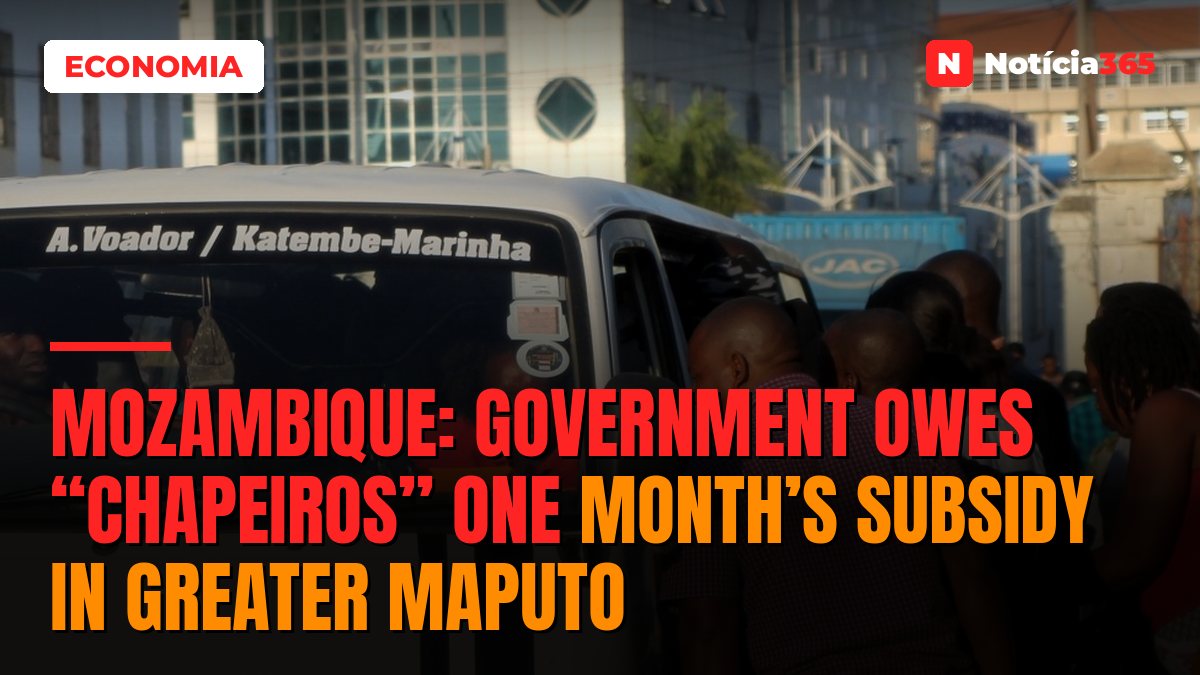
The Government owes operators of semi-collective passenger transport (‘chapeiros’) in the Greater Maputo Region one of the three months of subsidies approved to ease operating costs following the increase in fuel prices.
The implementation of subsidies for transport operators over a three-month period was discontinued because it was unsustainable. The Metropolitan Transport Agency (AMT) still owes the subsidy for July.
Iracema Mascarenhas, the AMT administrator responsible for technical affairs, cites the unsustainability of the measure as one of the reasons that led to the cancellation of subsidies for “chapeiros” and opened the way for fare adjustments.
“The subsidy for semi-collective transport operators was intended to ease operating costs following the increase in fuel prices. However, it became unsustainable, to the extent that the Government was only able to pay for two months,” she said.
She indicated that the fare adjustment under negotiation covers operators affiliated with FEMATRO and will be accompanied by stronger enforcement measures to combat overcharging and/or route shortening, in coordination with the Municipal Police and through reports from citizens, to prevent abuses.
“The introduction of the new fares is still under discussion. However, they may be announced in the coming days once a consensus has been reached,” she said.
Rodolfo Guambe, a transport operator, says he never received the proposed payments and welcomes the fare increase.
“The money was never paid, which affected operations. Therefore, the increase is more than necessary and should have been introduced some time ago,” he said.
Pedro Sambo, an operator on the Baixa–Novo Cemitério route, is one of the subsidy beneficiaries but says he received only one month’s payment.
“I received the money once; I don’t know about my colleagues. An increase of five meticais is not ideal. We expected at least 10 meticais, given the need to make operations sustainable. But it is important to bear in mind that passengers are also adversely affected,” he said.
Jorge Luís, who operates on the Malhazine–Anjo Voador route, says that even after submitting all the required documentation, he never received the subsidy.
“I was never included. The fare increase is the least the Government can do, because fuel prices have risen and the activity has become unsustainable,” he stressed.
Artur Muchai, a worker, says that although the increase will put further pressure on people’s pockets, it is justified and necessary.
“The Government needs to adjust fares in line with fuel costs. The dilemma is that salaries do not cover the cost of basic necessities,” he said.
Florentina Sarmento, a student, believes the impact of the increase will be devastating and that any fare adjustment must take into account the financial capacity of most passengers.
“The authorities must take salaries into account, as people are directly affected by rising prices for essential goods. I also suggest training for transport operators, fare collectors and “modjeiros” on ethics and behaviour, particularly on combating route shortening,” she reiterated.
Raimundo António, a worker, says the increase will make household budgets even harder to manage.
“The increase, even if it seems small, will make monthly budgets even more difficult to balance, as salaries are already insufficient to meet basic needs, making the cost of living even more burdensome,” he lamented.
Source: Notícias