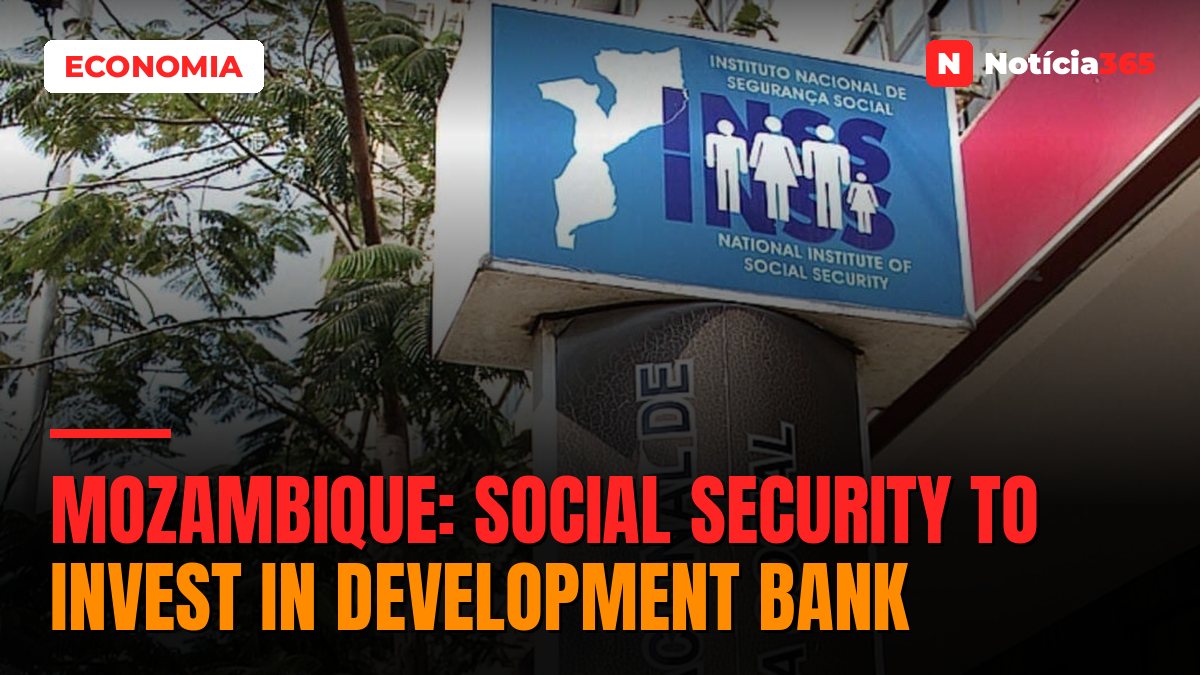
The Development Bank of Mozambique will receive part of the revenue from the extractive sector and up to 25% of Mozambique’s Social Security investments. The bank will have initial capital of 32 billion meticais (€444.4 million).
The regulation of the law establishing the Development Bank of Mozambique (BDM), recently published by the Government and accessed by Lusa today, stipulates that resources equivalent to “up to 25% of the investment portfolios of the Mandatory Social Security Funds managed by the National Social Security Institute (INSS)” may be invested in the bank “gradually”.
However, the legislation defines this limit only as the “maximum overall exposure” to the bank, with the actual amount depending on the financial position of the Social Security system, cash-flow requirements and the INSS investment strategy.
The regulation also provides that the INSS may “suspend, reduce or review” these investments if financial or actuarial studies indicate risks to the solvency, liquidity or profitability of the funds.
The BDM was established with share capital of 32,000 million meticais (€444.4 million), fully subscribed by the State, although the legislation allows for other investors to join in the future: “Part of it [the share capital] may be sold, up to a limit of 49%, to other entities, namely development finance institutions, multilateral banks and similar national and international institutions.”
In addition to Social Security resources, the bank may be financed with revenue from the extractive sector. The legislation stipulates that a percentage of State revenue generated by this activity must be channelled to the BDM, with the amount to be set annually through the State Budget Law, for “exclusive” use in structural projects and strategic infrastructure.
The institution’s mission will be to mobilise and channel medium- and long-term financing for projects considered strategic to the country’s economic development, operating as a development bank that complements commercial banks.
The regulation identifies agriculture, agro-industry, manufacturing, energy, infrastructure, logistics, tourism, the digital economy, mining and the local processing of natural resources as priority areas.
Financing will prioritise initiatives that have an impact on economic diversification, increased exports, import substitution, job creation and technology transfer.
The establishment of the bank fulfils one of the main promises made by Mozambican President Daniel Chapo at his inauguration in January 2025. In the proposal submitted to parliament in May this year, the head of state argued that the BDM constitutes “a strategic axis and one of the pillars for the structural transformation of the economy”, with the mission of “structuring, financing and driving forward strategic projects for the country’s progress”.
Chapo also said that the bank should be capitalised with resources generated by strategic assets, particularly natural gas, to finance projects with a direct impact on people’s lives and meet needs which, according to the Government, are not being adequately addressed by commercial banks, which are more focused on short-term, lower-risk operations.
The regulation also stipulates that entities within the State’s indirect administration and the state-owned enterprise sector must channel up to 25% of their respective financial investment portfolios and deposits to the bank during its first year of operation, with this subsequently rising to a minimum of 20%.
The chairperson of the Board of Directors will be appointed by the President of the Republic, while the remaining directors will be selected through a public competition.
The Government plans to make the Development Bank of Mozambique fully operational in 2027.