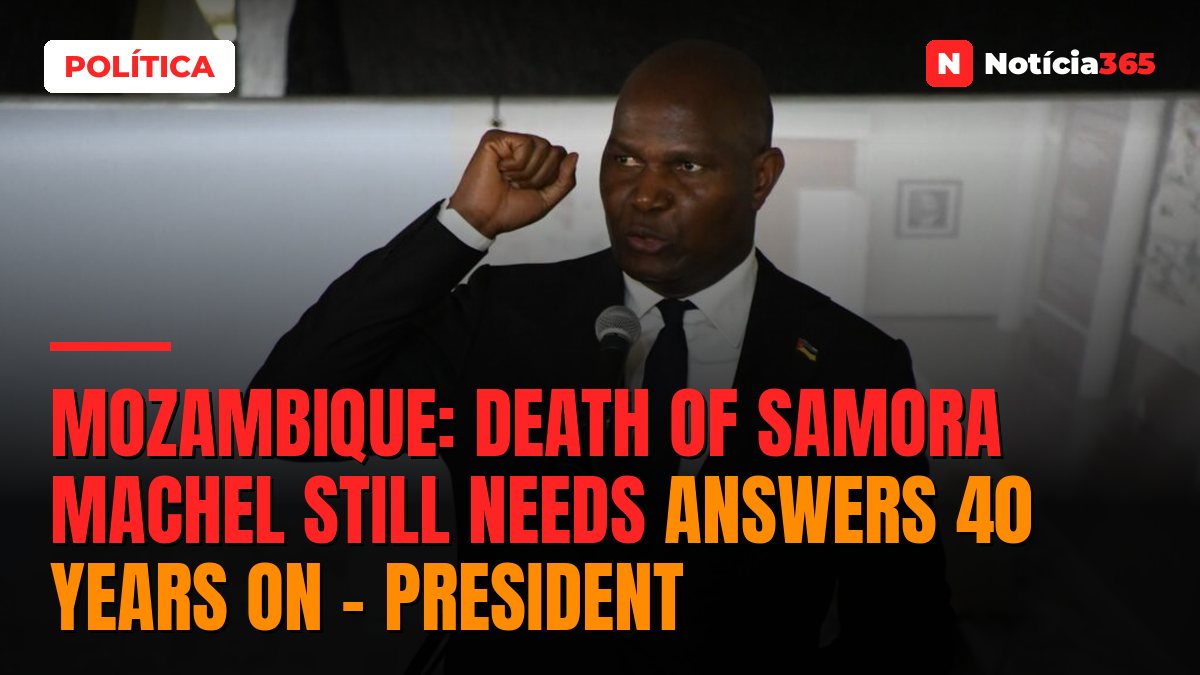
The Mozambican president on Monday called for a more thorough investigation into the death of Samora Machel, stating that, 40 years after the Mbuzini tragedy, doubts remain regarding the circumstances of the accident and that the victims’ families “deserve answers”.
“Forty years on, questions remain about the circumstances of the Mbuzini tragedy. The investigations and findings produced over the course of these decades have not dispelled all doubts,” Daniel Chapo said during a ceremony honouring the victims of the disaster of 19 October 1986, held at the Mbuzini memorial in South Africa’s Mpumalanga province.
Samora Machel, Mozambique’s first president after independence, died on 19 October 1986 when the presidential Tupolev-134 aircraft in which he was travelling crashed at Mbuzini, in north-eastern South Africa, near the Mozambican border. In addition to Machel, dozens of members of the presidential entourage and crew died in the crash, which continues to fuel debate about its causes.
Chapo said that the families of the victims of the Mbuzini disaster, as well as the peoples of Mozambique and South Africa, have the right to know “with accuracy and transparency” what happened that night.
“Forty years on, memory demands respect. The families deserve answers and history demands the truth,” he said.

Photo: South African Government, Department of Sport, Arts and Culture
In his address, Daniel Chapo paid tribute to Samora Machel and the other victims of the crash, also remembering the survivors, whom he described as “living witnesses” to the tragedy.
“We reiterate our solidarity and the Mozambican state’s commitment to preserving the memory of their loved ones and preserving their legacy,” he said.
Reflecting on Samora Machel’s legacy, Chapo argued that the legacy of Mozambique’s first head of state remains associated with the struggle for national unity, social justice and the liberation of the peoples of Southern Africa.
The president also said that peace was one of Samora Machel’s main political legacies, recalling that the former leader died while returning from a diplomatic mission linked to efforts to bring peace to the region.
“Forty years on, that mission remains very important. Peace is not merely the absence of weapons; it is the ability to live together despite our differences and resolve our problems through dialogue,” he said.
In this context, Chapo pointed to the ongoing national political dialogue in Mozambique as part of the pursuit of reconciliation and stability, also arguing that the current generation has a responsibility to turn political independence into economic independence.
“Samora Machel’s generation won the freedom of the homeland. It is up to our generation to turn that freedom into prosperity for the people,” he said.

Photo: South African Government, Department of Sport, Arts and Culture
The celebrations were held under the motto “Samora Machel, inspiration for the consolidation of peace and the achievement of economic independence” and brought together Mozambican and South African authorities, victims’ relatives, survivors and diplomatic representatives.
Born on 29 September 1933 in Gaza province, Samora Machel worked as a nurse before leaving the country in 1963 to join the Mozambique Liberation Front (Frelimo), which had been founded the previous year in Tanzania.
He went on to take command of the Mozambique Liberation Armed Forces, became Frelimo’s leader following the assassination of Eduardo Mondlane in 1969, and proclaimed national independence on 25 June 1975, becoming the country’s first president.