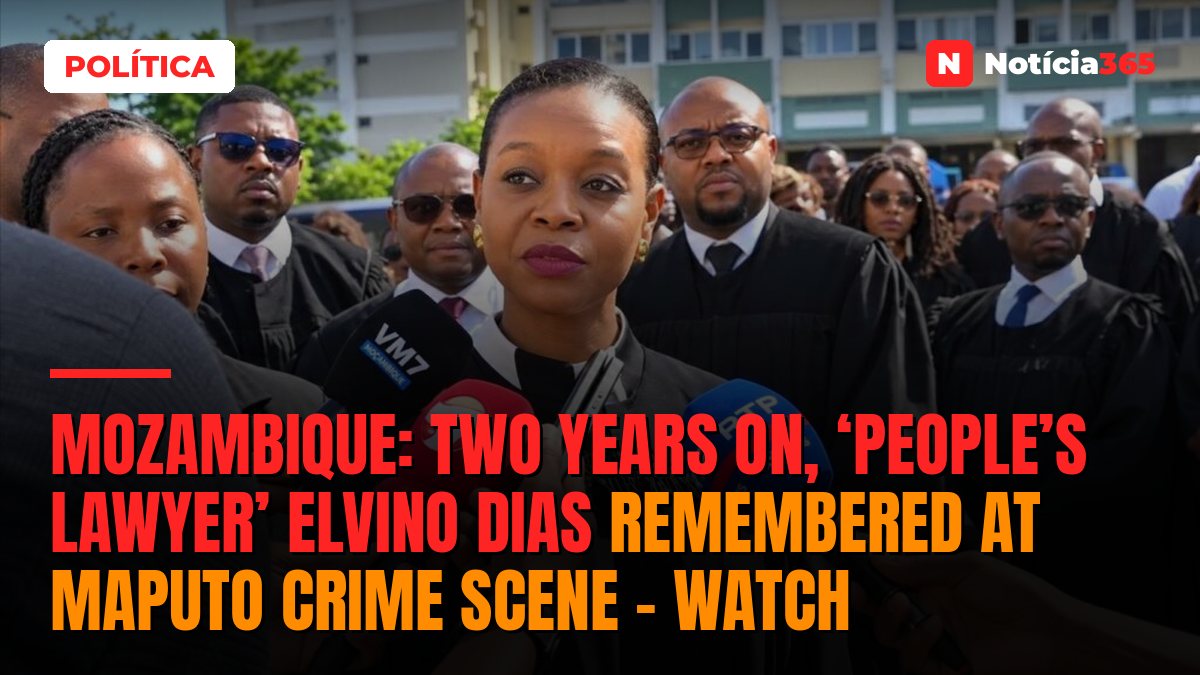
Several dozen lawyers gathered again in Maputo today at the scene of the double murder committed exactly two years ago, demanding answers about the crime that claimed the life of Elvino Dias, known as the “people’s lawyer”.
“We continue to apply pressure and continue to seek these answers,” Thera Dai, president of the Mozambique Bar Association, told journalists after a wreath was laid at the crime scene in the heart of Maputo.
Elvino Dias, known for his social causes and the support he provided, particularly to the most disadvantaged, died in an ambush on the night of 18 to 19 October 2024. The crime remains unexplained and has since been associated with political motives.
At the time, he was legal adviser to politician Venâncio Mondlane – who was running for President of the Republic – and the car he was driving in central Maputo was intercepted by two vehicles. Armed men got out and fired dozens of shots, killing not only Elvino Dias, 45, but also Paulo Guambe, the representative of Podemos, the party that supported that presidential candidate in the elections held a few days earlier.
“We will remain steadfast and present to follow the investigations, above all so that the family can have the deceased’s belongings returned to them. These have still not been returned to date,” the president of the Bar Association lamented.
“We believe that every lawyer must be able to practise their profession in a context of freedom and independence, regardless of any sensitivities that might be affected or might not be affected, but a lawyer’s independence must never be compromised,” she stressed.
For the third time, as they had done immediately after the crime and on the first anniversary, dozens of lawyers wearing their robes made their way this morning to the scene of the double murder to pay tribute to the lawyer. This was the first time the Bar Association had marked the day established to defend the profession.
“Our Committee on Lawyers’ Prerogatives, and the Bar Association in particular, has been applying pressure and seeking these answers, and we will not stop. We will remain steadfast, and the 19th, as has already been stated, was established and formalised by the Bar Association as National Day of Lawyers’ Prerogatives, Defence of Prerogatives,” Thera Dai said.
“A lawyer cannot practise in a context of coercion, where they are restricted. It is necessary to ensure that lawyers can practise independently,” the president of the Bar Association added, recalling that Elvino Dias was also “a staunch defender of lawyers’ prerogatives”.
“Although this day is laden with pain for the profession, absolutely the entire profession, we will not stop and will continue to promote the defence of lawyers’ prerogatives. Lawyers must be free and independent and must practise their profession with dignity and respect,” she concluded.
At the scene, Nelson Cossa, president of the Bar Association’s Committee for the Defence and Strengthening of Lawyers’ Prerogatives, acknowledged the “convenience” of the lack of answers in this case, despite criminal investigation authorities being able to solve other cases within 24 hours: “We see our justice administration system as energetic when it chooses to be, and lifeless when it also chooses to be. I have said that we have a justice administration system that responds swiftly or does not respond at all, depending on what is inconvenient.”
He acknowledged that the Mozambique Bar Association must “fight” and “cooperate with the justice administration authorities” to “reverse this trend”, as well as demand “not only that justice be done, but that it be done in a timely manner so that it serves some useful purpose for society”.
Following the double murder, amid the dispute over Mozambique’s 2024 general elections, five months of protests ensued, with more than 400 deaths recorded in clashes with the police, alongside widespread destruction and looting of public and private property.
In April this year, the Attorney-General, Américo Letela, revealed that two people had been detained among three suspects questioned in the case of the murders of Elvino Dias and Paulo Guambe. He acknowledged that there were “major challenges” given the “various lines” of investigation.