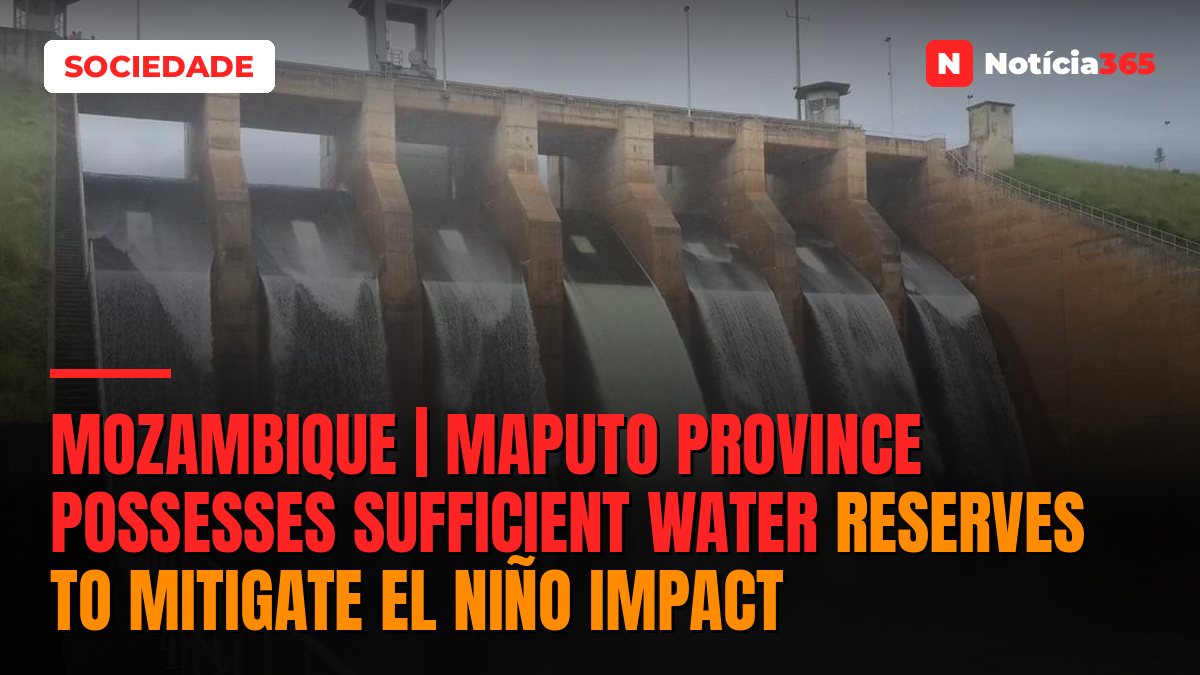
The Governor of Maputo Province, Manuel Tule, assured that the province maintains water storage levels above 80 percent in the Pequenos Libombos and Corumana dams to sustain agricultural production for the 2026–2027 season, which faces threats from rainfall deficits associated with the El Niño phenomenon.
The Governor was speaking Thursday in Matola City during the opening of the 1st Coordinating Council of the Ministry of Agriculture, Environment, and Fisheries (MAAP), where he highlighted climate challenges impacting preparations for the second 2026–2027 agricultural campaign.
“Both dams are holding above 80 percent of their total capacity. To ensure water supply and further boost output, the province also relies on nine excavated retention reservoirs, whose storage levels range between 40 and 100 percent,” he stated.
According to the official, the province projects an output of 3.3 million metric tons of diverse agricultural products and 19,000 metric tons of fish during the campaign, despite unfavorable meteorological forecasts.
According to Tule, the 2025–2026 agricultural campaign was severely affected by intense rainfall and flooding, which caused significant losses across several farming areas.
For the upcoming season, forecasts from the National Institute of Meteorology (INAM) point to significant influence from El Niño, characterized by scarce rainfall that could compromise crop and livestock production in Maputo Province and throughout central and southern regions.
“According to forecasts by the National Institute of Meteorology, the second 2026–2027 agricultural campaign will also be significantly affected by El Niño—a phenomenon characterized by rainfall deficits that could compromise crop and livestock production across our province and the entire central and southern region,” he explained.
To mitigate drought impacts, the Provincial Executive Council, in collaboration with development partners, plans to assist farmers with seeds and other inputs, including beans, cassava cuttings, sweet potato vines, short-cycle maize varieties, and other crops.
The province also intends to scale up fisheries production, viewed as a strategic alternative to offset drought effects.
Tule affirmed that seed distribution conducted earlier in the year with partner support is already contributing to a strong recovery in agricultural production and market supply.
“Currently, as a result of the seed distribution work carried out with your support at the start of the year, we are observing a robust recovery in production across our province. Our markets are well supplied. The population has access to food purchases,” he declared.
“We face challenges, but we are not standing still; we are actively working,” he added.
In turn, the Mayor of Matola, Júlio Parruque, emphasized the importance of urban and peri-urban agriculture, advocating for the preservation of green spaces against urban development pressures.
Parruque further noted the need for support to improve urban drainage systems, strengthen local fisheries, and refine environmental management and municipal solid waste handling.