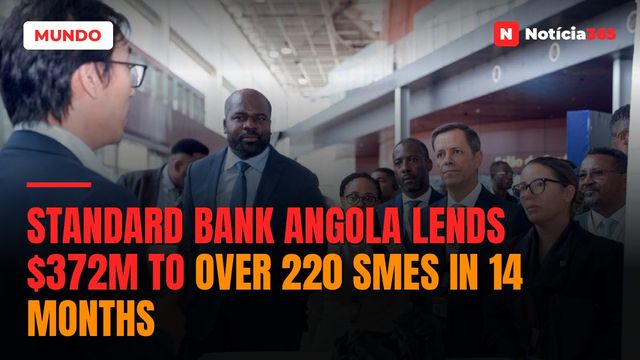
Standard Bank Angola (SBA) has extended more than 340 billion kwanzas (US$372.4 million) in financing to over 220 micro, small and medium-sized enterprises (SMEs) over a period of 14 months. The lending stems from memoranda of understanding signed with the National Institute for Support to Micro, Small and Medium Enterprises (INAPEM) in June 2025, and with the Ministry of Fisheries and Marine Resources in November of the same year.
The figures were disclosed at the first edition of the Angolan Production Fair (FEPA), held on Wednesday, 21 October, at the Talatona Convention Centre in Luanda, according to a statement issued to Diário Económico. Organised by SBA through its Small and Medium Enterprise Banking division, the fair brought together 50 exhibitors with the aim of connecting producers, entrepreneurs, investors and consumers, fostering business contacts and facilitating knowledge sharing.
At the opening ceremony, Fernando Chivinda, SBA’s Executive Director for Small and Medium Enterprise Banking, revealed that 57% of the financing went to industry and consumption, 18% to transport and logistics, and 16% to the oil and gas sector. Mining and agriculture each received 4%, while fisheries accounted for 2%.
The financing reached 12 provinces and was associated with the creation of more than 7,000 direct jobs and over 10,000 indirect jobs. According to Fernando Chivinda, the memoranda rest on three pillars: “business capacity building, market access and access to credit.” He added that the bank finances projects that boost domestic production, reduce imports and promote food security, noting that some clients are already exporting their products.
Luís Teles, Chief Executive of SBA, made the case for the role of banks in economic development. “A bank captures resources from the economy and has a responsibility to transform them into growth opportunities,” he said. In his view, credit should translate into production, new equipment, greater installed capacity, job creation and more competitive enterprises.
Teles also emphasised that business growth depends on access to markets, knowledge, technology and distribution networks. “We do not want to be just the bank where companies hold an account. We want to be the partner that helps them grow,” he said, adding that FEPA itself contributes to that growth by bringing together producers, entrepreneurs, investors, consumers and institutions.
The fair also featured the participation of Andrew Mashanda, Standard Bank Group’s Director for Small and Medium Enterprise Banking for Africa and Offshore. “Angola has ceased to be merely a market of opportunities. Today, it is a reference for growth, innovation and transformation in Africa,” he said. The group’s delegation included representatives from Zambia, Mozambique and Tanzania, as well as colleagues from South Africa, with the objective of strengthening business links and supporting the internationalisation of Angolan enterprises.
Mashanda advocated for partnerships between companies and markets to drive business. “We want to build bridges, bring companies closer together and accelerate the internationalisation of Angolan businesses,” he stated. In his view, connecting companies, sectors, markets and countries creates opportunities, promotes development and contributes to regional prosperity.
Bráulio Augusto, Chair of the INAPEM Board of Directors, underscored the importance of FEPA at a moment when Angola is seeking to strengthen domestic production and increase the contribution of industry and commerce to economic diversification, job creation and improved living standards. He also called for improvements in access to financing and markets, in logistical capacity and in the quality standards of enterprises.
For Bráulio Augusto, the African Continental Free Trade Area (AfCFTA) represents an opportunity for Angolan companies, provided they can compete on quality, price, supply regularity and certification. “May this fair allow lasting commercial relationships to be established, viable investments to be identified, and contacts to be transformed into concrete business,” he concluded.
Source: Diário Económico
Original article: https://www.diarioeconomico.co.mz/2026/10/22/mundo/angola/angola-standard-bank-financiou-mais-de-220-mpme-em-14-meses/
The post Standard Bank Angola Lends $372M to Over 220 SMEs in 14 Months appeared first on 360 Mozambique.