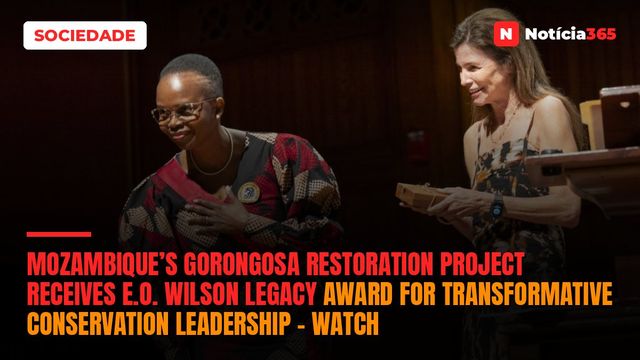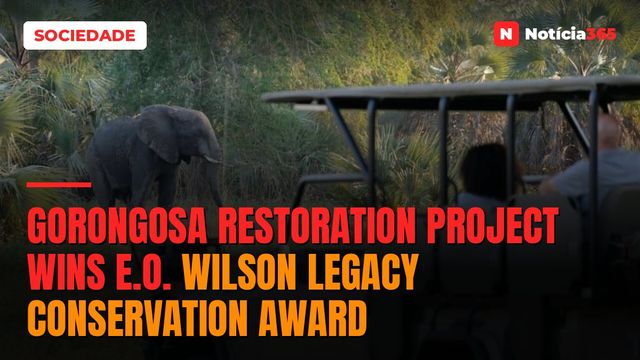
The Gorongosa Restoration Project has received the E.O. Wilson Legacy Award for Transformative Leadership in Conservation, in recognition of its work restoring ecosystems, preserving biodiversity, and supporting the development of local communities. The prize was presented on 12 October at Harvard University in the United States.
Aurora Malene, president of the project, accepted the award at Sanders Theatre in Cambridge, Massachusetts, during the Half-Earth Day 2026 celebrations. The prize was presented by Paula J. Ehrlich, president of the E.O. Wilson Biodiversity Foundation, and recognises the contributions of scientists, rangers, and field teams working alongside communities neighbouring the park in the areas of education, health, forestry, and agriculture.
The Gorongosa Restoration Project succeeds actor and conservationist Harrison Ford, who received the inaugural edition of the award in Chicago in October 2025. The prize honours the legacy of American biologist Edward O. Wilson, a former Harvard professor and an internationally recognised authority on biodiversity.
In a video message, Ford evoked the scientist’s deep connection to the Mozambican park and highlighted the work carried out by its teams over more than two decades.
“Ed Wilson loved Gorongosa. He said it was just as it was before the arrival of humanity,” Ford said. He also underscored the role of rangers, scientists, teachers, doctors, and young Mozambicans in sustaining the conservation effort.
Located in Sofala province, Gorongosa National Park suffered a severe collapse in large animal populations during Mozambique’s civil war. Recovery gained renewed momentum in 2008 with the establishment of a public-private partnership between the Government of Mozambique and the Carr Foundation, led by American philanthropist Greg Carr.
The model combines management of the protected area with development programmes for surrounding communities, encompassing education, health, agriculture, and the creation of economic opportunities.
Scientific research forms another core component of the project. The E.O. Wilson Biodiversity Laboratory, inaugurated in 2014, supports the study of Gorongosa’s species and ecosystems as well as the training of researchers.
Across the Greater Gorongosa landscape, approximately 8,000 species have been recorded, including around 200 that are new to science. The knowledge generated helps guide conservation measures and track the recovery of the protected area.
Source: Diário Económico
Original article: https://www.diarioeconomico.co.mz/2026/10/19/economia/conservacao/gorongosa-conquista-premio-internacional-de-conservacao-ambiental/
The post Gorongosa Restoration Project Wins E.O. Wilson Legacy Conservation Award appeared first on 360 Mozambique.