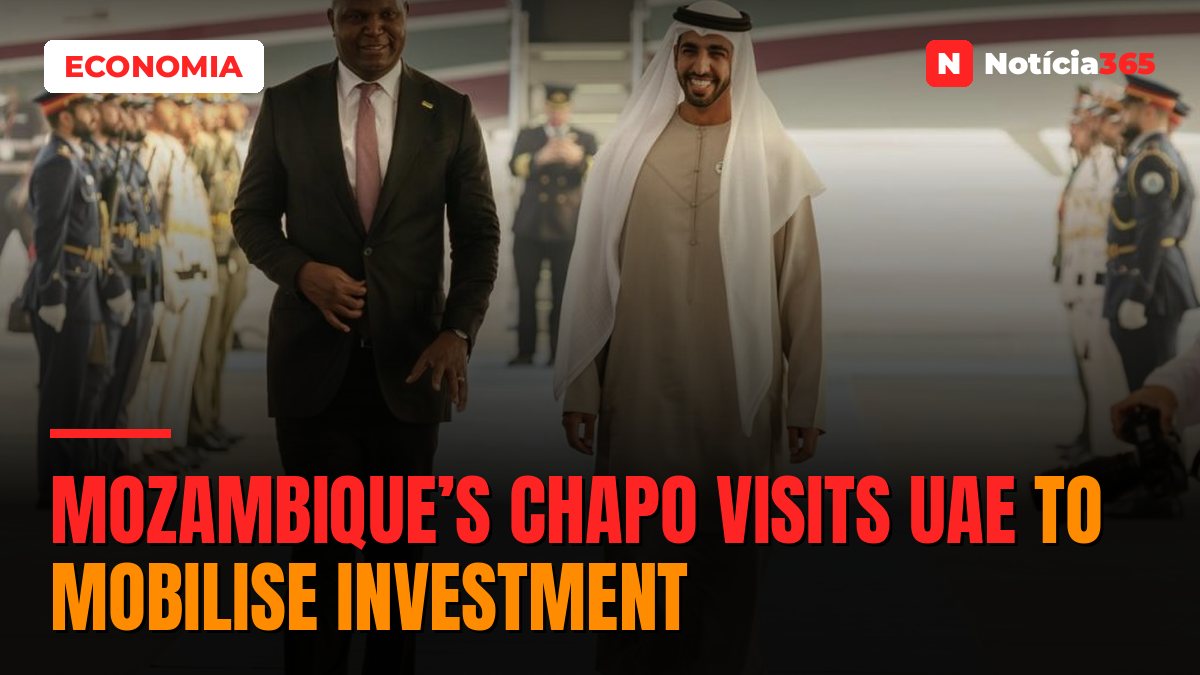

President Daniel Chapo on Friday began a three-day working visit to the United Arab Emirates (UAE), aimed at reinforcing bilateral economic cooperation and mobilising public and private investment into strategic sectors of the Mozambican economy.
The visit, which runs until Sunday, 15 November, was made at the invitation of UAE President Mohammed bin Zayed Al Nahyan and forms part of the government's efforts to deepen political and economic relations between the two countries.
According to a statement from the Presidency cited by the Mozambique Information Agency (AIM), the visit seeks to consolidate understandings reached between Maputo and Abu Dhabi, as well as to identify new partnership opportunities that could contribute to national economic development.

The agenda fits within Mozambique's broader strategy of promoting foreign investment, seeking to create conditions for greater participation of UAE public and private capital in activities considered priorities for the growth of the Mozambican economy.
The Presidency said the trip also represents an opportunity to strengthen the bonds of friendship, solidarity, and political and economic cooperation between the two states, building on diplomatic contacts intended to deepen bilateral relations.
The visit may allow for the identification of new areas of cooperation and business opportunities, although the statement does not specify which sectors will be prioritised in negotiations, the investment amounts sought, or any agreements that may be formalised during the trip.
Chapo is accompanied by First Lady Gueta Chapo, Minister of Foreign Affairs and Cooperation Maria Manuela dos Santos Lucas, Minister in the Presidency for Civil House Affairs Ricardo Sengo, and Minister of Economy Basílio Muhate.
The delegation also includes officials from the Presidency and other state institutions, who are expected to participate in institutional meetings and cooperation initiatives planned during the visit.
The presidential trip takes place as Mozambique seeks to strengthen relations with international partners and attract financial resources to support the development of strategic economic sectors through the mobilisation of investment and the deepening of bilateral cooperation.
Source: Diário Económico
Original article: https://www.diarioeconomico.co.mz/2026/11/13/negocios/pr-visita-emirados-arabes-unidos-para-mobilizar-investimentos-na-economia-nacional/