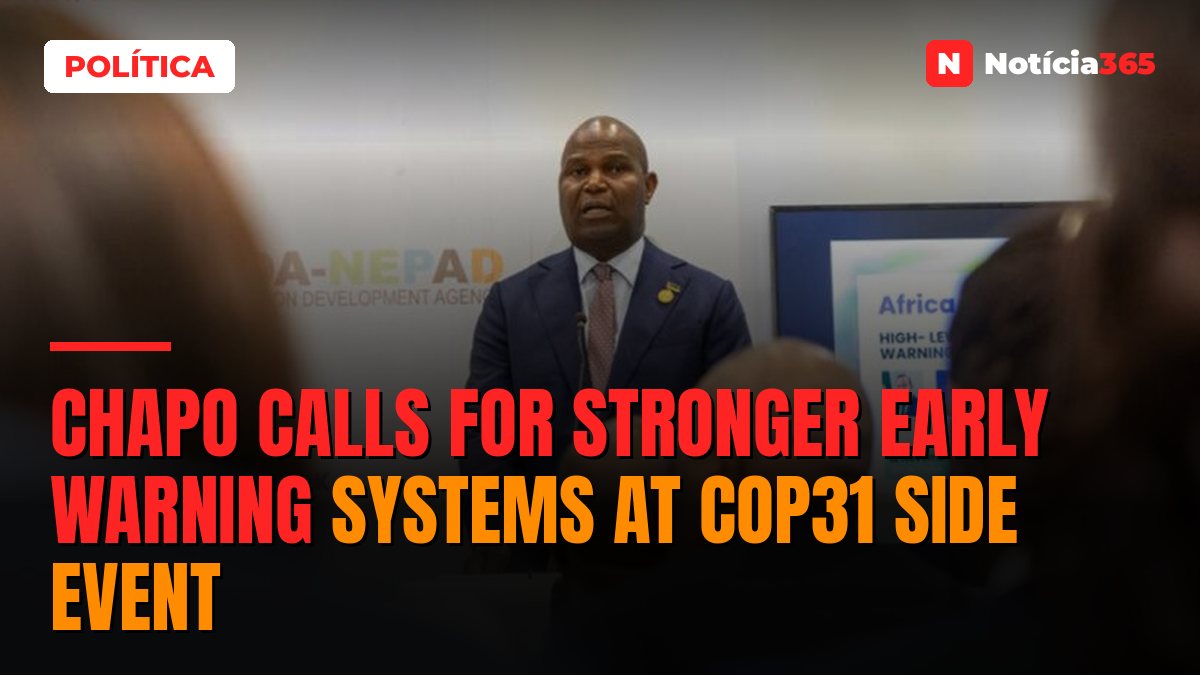

Mozambican President Daniel Chapo has called for greater investment in early warning systems and climate disaster response capacity across Africa, arguing that stronger preparedness infrastructure is essential to saving lives, reducing economic losses, and protecting vulnerable communities.
Chapo made the remarks on Thursday, 12 November, in Antalya, Turkey, at a high-level meeting held on the sidelines of the 31st United Nations Climate Change Conference (COP31).
Cited by newspaper O País, the head of state argued that Africa’s growing exposure to climate risks demands systems capable not only of generating meteorological data, but of ensuring that alerts reach communities in time to enable an effective response. He also identified the El Niño phenomenon as one of the key factors reinforcing the urgency of strengthening prevention mechanisms.

Chapo noted that 41 African countries currently report having early warning systems in place, with the depth and coverage of those systems having more than doubled since 2022. He acknowledged, however, that significant gaps persist in observation and weather forecasting infrastructure, in the transmission of alerts to remote areas, in institutional coordination, and in access to sustainable financing.
In his address, the president emphasised that these systems must above all respond to the needs of the groups most exposed to climate risks, including farmers, women, youth, persons with disabilities, and populations in remote areas.
Drawing on Mozambique’s own experience, Chapo highlighted the recurring impact of droughts, floods, and tropical cyclones on communities, infrastructure, and national production. In that context, he stressed the importance of prioritising prevention, arguing that investment in preparedness can substantially reduce the human and economic costs associated with post-disaster reconstruction.
To accelerate implementation of the continental agenda, Chapo identified four priorities: elevating prevention and early warning systems to the level of core policy priorities; strengthening national investment and mobilising sustainable international finance; deepening cooperation among African states; and developing inclusive systems accessible to local communities.
The head of state also called for the use of science, technology, and artificial intelligence to improve risk forecasting and bring critical information closer to both decision-making centres and affected populations.
In that regard, he highlighted progress under the African Multi-Hazard Early Warning and Early Action Programme, as well as the operationalisation of Situation Rooms at continental, regional, and national levels.
Chapo further urged that commitments made at such forums be translated into concrete action, warning that a lack of information, preparedness, and response capacity will continue to worsen the impacts of extreme climate events across the continent.
The Mozambican president currently serves as the African Union Champion for Disaster Risk Management, a role originally assigned to his predecessor, Filipe Nyusi, in February 2022 during the 35th Ordinary Session of the African Union Assembly held in Addis Ababa, Ethiopia. The designation reflects Mozambique’s recognised role in disaster risk prevention and management, underpinned by the country’s extensive experience responding to extreme climate events including cyclones, floods, and droughts.
Source: Diário Económico
Original article: https://www.diarioeconomico.co.mz/2026/11/13/economia/desenvolvimento/cop31-nova-avaliacao-dos-funcionarios-publicos-pode-determinar-cessacao-de-funcoes/