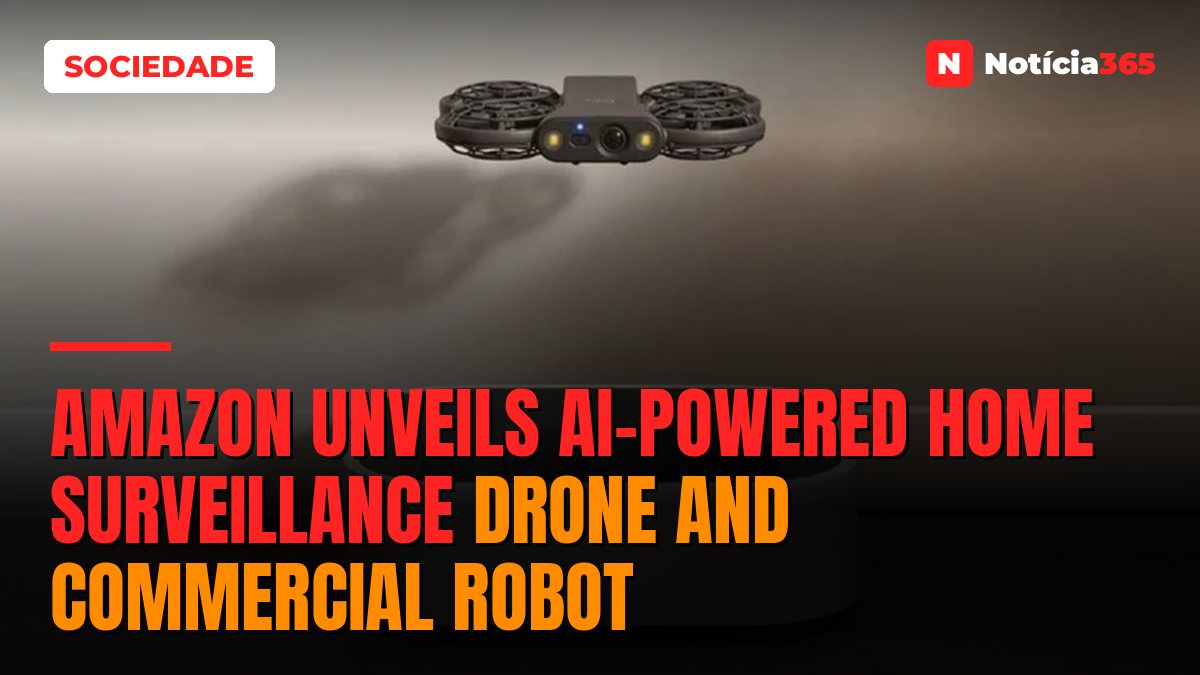

Amazon has unveiled the Ring Drone Cam, an AI-powered home surveillance drone capable of autonomously launching from its base to inspect rooms inside a residence after a security alert is triggered. Developed by Ring, Amazon’s residential security and smart device subsidiary, the product was presented alongside the Ring Rover Cam, a patrol robot designed for commercial spaces such as retail stores and warehouses.
Both devices form part of the new Ring Robotics line and use artificial intelligence systems to map spaces, plot routes, and avoid obstacles during operation.
The Ring Drone Cam is designed to allow users to verify suspicious situations inside their homes even when they are away. When a compatible sensor detects activity, the device can lift off from its charging station, navigate to a pre-defined point, and stream live footage through the Ring app.

The drone operates using the AI Pilot system, which maps spaces during initial setup. In this phase, the user carries the device through the rooms they wish to monitor, allowing the system to create an internal representation of the home and identify surveillance points such as doors and windows.
Once configuration is complete, users can schedule patrol routes, request flights through the app, or have the device activated automatically via compatible sensors.
Weighing 165 grams, the Ring Drone Cam captures footage at 2K resolution and is equipped with two LED lights to aid surveillance in low-light environments. Amazon states the battery life ranges between five and eight minutes per charge.
The device requires a Wi-Fi connection to operate and has been designed to land automatically if connectivity is lost mid-flight.
In addition to the home drone, Amazon unveiled the Ring Rover Cam, a wheeled robot developed to enhance security in commercial establishments, warehouses, and other business premises. The device draws on technology from Astro, the domestic robot Amazon introduced in 2021, adapted to meet corporate security requirements.
Among its key features is a camera mounted on an extendable mast, enabling it to capture footage above counters and shelving. During patrol rounds, the robot streams and records video at up to 4K resolution, is equipped with a siren, and supports two-way communication through the app.
In the United States, Amazon plans to begin deliveries of the Ring Rover Cam on 16 December 2026, priced at US$999.99. The Ring Drone Cam is scheduled for launch on 27 January 2027 at US$249.99, subject to authorisation from the US Federal Communications Commission (FCC).
Privacy and Image Protection
The introduction of autonomous cameras capable of moving through different rooms inside a home raises questions around privacy, image collection, and access to recordings.
According to Amazon, the Ring Drone Cam’s camera remains switched off while the device is docked at its charging station, beginning to record only when activated for a flight. Both devices are equipped with indicator lights that signal when footage is being captured.
The company states that videos will be protected by its TAKE (Throw Away the Key Encryption) system. This mechanism uses encryption keys that are temporarily made available to Ring’s services for image processing before being deleted from the company’s servers.
Unlike end-to-end encryption, the TAKE system does allow Ring temporary access to the keys required to operate certain cloud-based features during a limited window.
Privacy concerns carry particular weight given prior criticism directed at Ring over access to private recordings and the sharing of footage with law enforcement authorities without owner consent or a court order, according to Exame magazine.
With the new Ring Robotics line, Amazon is seeking to extend the use of robotics and artificial intelligence into home and commercial security, betting on devices capable of performing surveillance tasks autonomously.
Source: Diário Económico
Original article: https://www.diarioeconomico.co.mz/?p=560806