
British consultancy Oxford Economics has warned that a lack of financing remains one of the principal obstacles to the energy transition in Africa — a continent that requires approximately $15 billion per year in investment to achieve universal electricity access by 2035, according to the International Energy Agency (IEA).
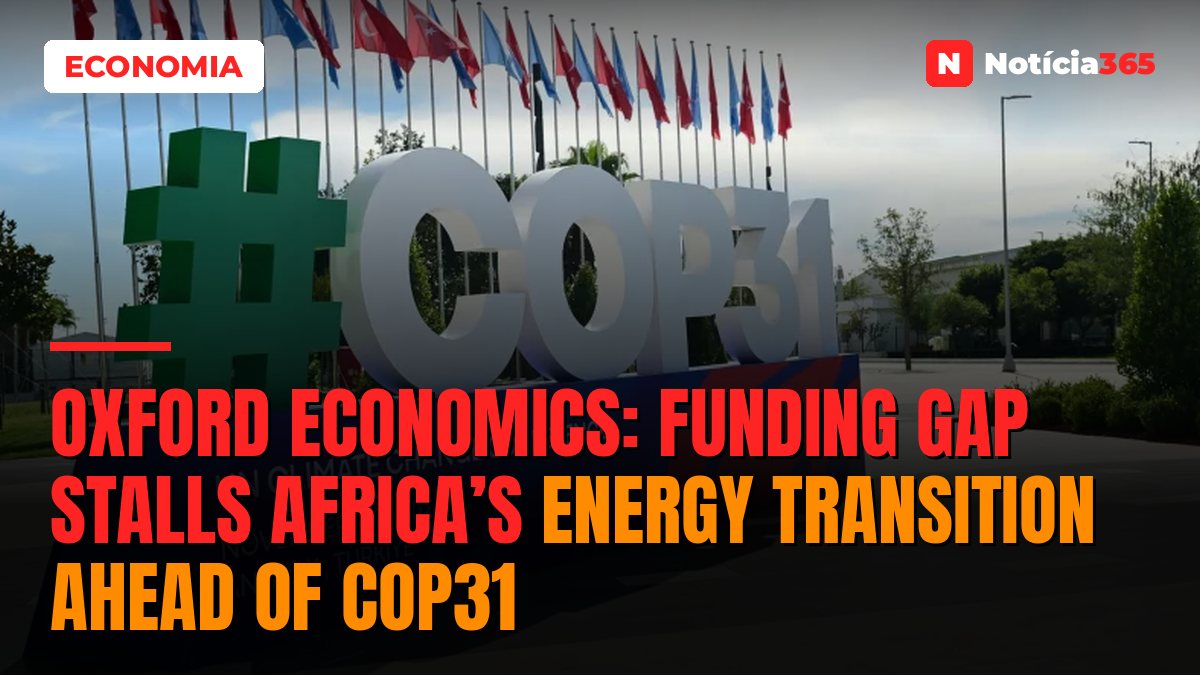
The alert comes as the 31st United Nations Climate Change Conference (COP31) gets under way, running from 9 to 20 November in Antalya, Turkey. Oxford Economics described the conference as a test of governments' ability to convert climate commitments into concrete investment, according to the Lusa news agency.
In an analysis circulated to clients — to which Lusa gained access on Monday, 9 November — analysts from Oxford Economics' Africa division argued that COP31 should focus on implementing agreements already reached, rather than negotiating new commitments. One of the central challenges, the consultancy said, is securing the financing needed to accelerate the electrification of African economies, in a context where millions of people remain without electricity access and investment in generation, transmission, and distribution continues to fall short.

According to an IEA report, approximately 600 million Africans live without access to electricity. The agency estimates that around $150 billion in investment will be required by 2035 to guarantee universal access across the continent — equivalent to roughly $15 billion per year. The absence of electricity constrains industrial development, business productivity, and improvements in living standards.
The Oxford Economics Africa team argued that COP31 should prioritise implementation of commitments already on the table rather than the negotiation of new pledges.
For Oxford Economics, broadening energy access is an essential precondition for African countries to participate effectively in the global energy transition without sacrificing their economic growth and poverty reduction objectives.
The analysis highlights the '35 by 35' Global Electrification Pledge — a voluntary target aimed at raising electricity's share of global final energy consumption from just over 20 percent to 35 percent by 2035. Meeting that goal will require significant investment in grid modernisation, energy storage, and technologies that reduce dependence on fossil fuels.
In Africa, analysts noted, the challenge is more complex: many countries must first expand basic electricity supply infrastructure before they can accelerate the replacement of traditional energy sources. Climate finance should therefore occupy a central role in COP31 negotiations, particularly regarding the responsibility of developed economies to support countries most vulnerable to climate change.
According to Oxford Economics, the African negotiating bloc has asked the United Nations to add three formal items to the COP31 agenda: a tripling of adaptation finance, the relationship between trade and climate change, and the funding mechanisms of the Green Climate Fund.
Adaptation is expected to be one of the main points of contention between developed and developing countries, largely due to the difficulty of translating international commitments into actual disbursements. At COP30, held in Belém, Brazil, in 2025, countries committed to seeking at least a tripling of adaptation finance for developing nations by 2035. However, during negotiations in Bonn, Germany, in June 2026, developing countries sought to enshrine that commitment in the text on adaptation, and several advanced economies objected.
For the British consultancy, these difficulties illustrate that the central question is no longer simply about setting climate targets, but about the capacity of governments and international financial institutions to mobilise the resources required to meet them. Analysts also stressed that for the majority of African countries, economic growth, industrialisation, and poverty reduction remain the overriding priorities — meaning the energy transition must be aligned with those objectives.
African negotiators have consequently argued that industrialised economies, historically responsible for a significant share of greenhouse gas emissions, should assume greater responsibility for financing the decarbonisation efforts of developing nations.
Source: Diário Económico
Original article: https://www.diarioeconomico.co.mz/2026/11/10/desenvolvimento-2/cop31-falta-de-financiamento-trava-transicao-energetica-em-africa-alerta-oxford-economics/