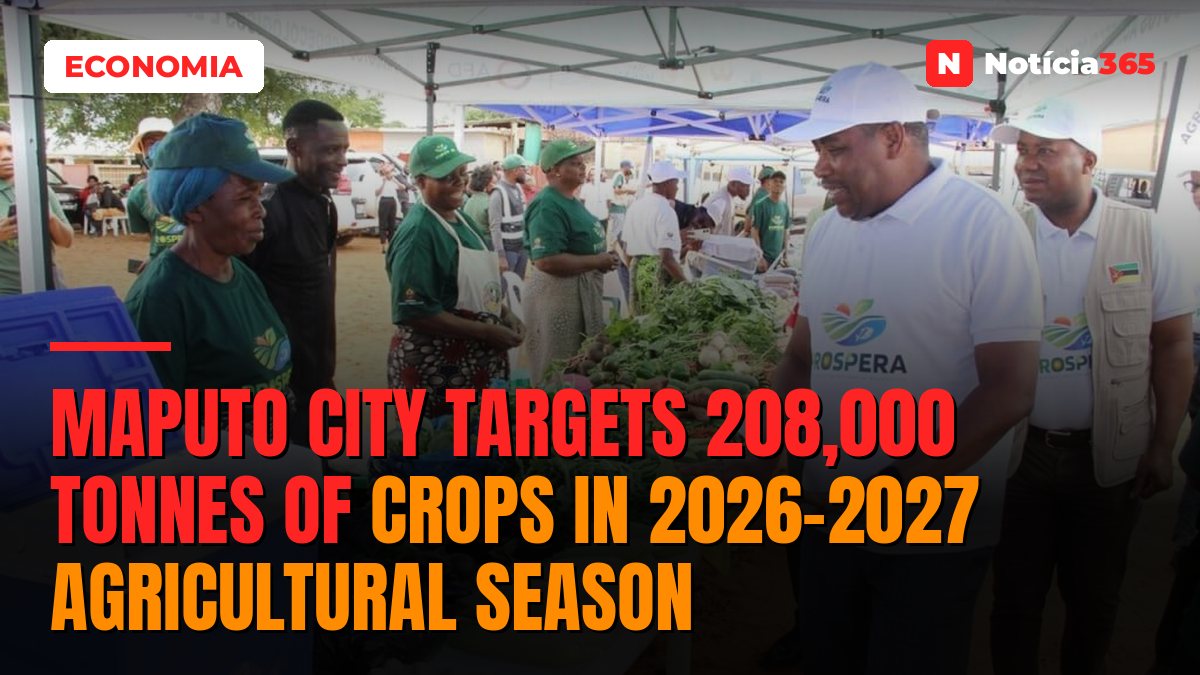

The Maputo City Government is targeting production of 208,387 tonnes of diverse crops and 401,721 dozen eggs during the 2026-2027 agricultural season, with the aim of increasing food availability, generating income, and reducing dependence on imports, according to the Mozambique Information Agency.
The targets were announced by Vicente Joaquim Imede, Secretary of State for Maputo City, at the official launch of the agricultural season, held in the KaMubukwana municipal district under the slogan 'Let Us Produce to Feed Mozambique'.
Agricultural production is expected to grow by 3.3%, up from the 3% recorded in the previous season, over a cumulative area of 8,632.1 hectares. Vegetables are set to account for the largest share, with 203,014.1 tonnes, followed by roots and tubers (4,092.5 tonnes), legumes (1,140.8 tonnes), and cereals (140.1 tonnes).
Livestock Production and Climate Risks
In the livestock sector, the city also plans to produce 8,624.6 tonnes of chicken meat, representing growth of 2.1%, while egg production is projected to increase by 1.9%.
At the municipal district level, KaMavota is expected to lead production with 127,320.2 tonnes, followed by KaMubukwana with 65,543.3 tonnes, KaTembe with 15,018.3 tonnes, and KaNyaka with 505.5 tonnes.
The campaign is taking place against a backdrop of risks associated with the El Niño phenomenon, which could cause below-average rainfall, prolonged dry spells, and high temperatures, particularly in the central and southern regions of the country. In Maputo City, approximately 16,000 farmers and livestock producers are estimated to be at risk.
Agricultural production is expected to grow by 3.3%, up from the 3% recorded in the previous season, over a cumulative area of 8,632.1 hectares. Vegetables are set to account for the largest share, with 203,014.1 tonnes, followed by roots and tubers (4,092.5 tonnes), legumes (1,140.8 tonnes), and cereals (140.1 tonnes).
In response to this scenario, the government and its partners are studying assistance mechanisms for 2,175 families through the provision of an equivalent number of agricultural input kits.
Vicente Joaquim Imede called on producers to 'adopt short-cycle and drought-tolerant varieties, diversify crops, and strengthen water and soil conservation practices'.
Digital System to Monitor Seed Quality
He also highlighted the implementation of the Seed Traceability and Labelling System, a digital tool that will allow users to verify the authenticity, origin, and quality of seeds through QR codes, USSD, and SMS.
The initiative aims to combat the circulation of counterfeit seeds and protect farmers' investments.
At the event, Vicente Joaquim Imede reiterated the importance of agriculture for job creation, income generation, poverty reduction, and improving the living conditions of families.
Source: Diário Económico
Original article: https://www.diarioeconomico.co.mz/?p=559916