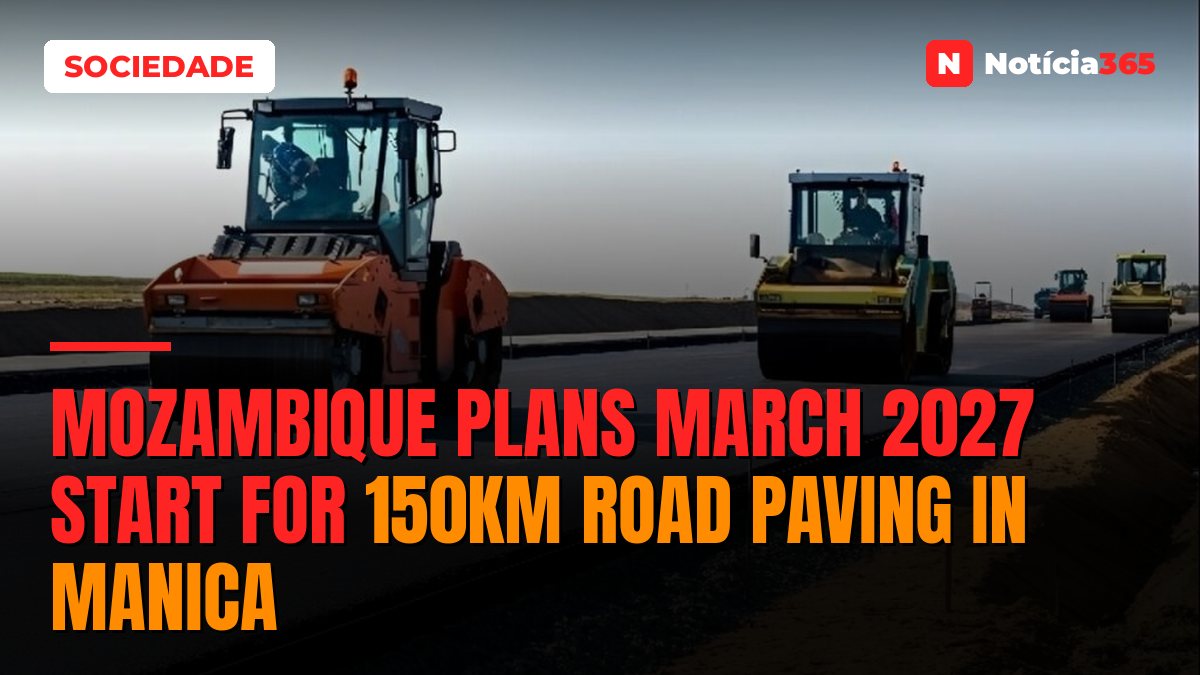

The Mozambican government plans to begin asphalting approximately 150 kilometres of roads across three districts in Manica province, in the centre of the country, in March 2027, under its ‘Mais Estradas – 2031’ (More Roads – 2031) programme. The initiative aims to improve the movement of people and goods and strengthen road connectivity, with particular attention to areas facing accessibility challenges.
The first phase of the works covers three road sections: Espungabera–Chiurairwe, on Regional Road 441 (ER-441), spanning 36 kilometres; Chimoio–Macate, on the ER-523, covering 42 kilometres; and Dombe–Chitausse, on National Road 1 (EN1), extending 52 kilometres. These interventions form part of the recently launched government programme, which prioritises improving road usability and expanding the coverage of paved roads.
Mozambique currently has a road network of approximately 30,000 kilometres, of which only 8,400 — equivalent to 28% of the total — are paved. In Manica province, the road network extends around 3,000 kilometres, with just 900 kilometres having an asphalt surface. Through the programme, the government aims to raise the proportion of paved roads nationally from the current 28% to 38%.
The details of the intervention were presented by Moisés Dzimba, the provincial delegate of the National Roads Administration (ANE) in Manica, at a meeting held in the district of Mossurize with representatives of the district government. “We came to present to the local authorities, community leaders and the beneficiary population the planned road projects, their objectives and the benefits of their implementation,” he said.
“We expect several socioeconomic benefits during the main stages of project implementation. That is why we are asking the population to be part of this undertaking, as these infrastructures belong to the people.” — Moisés Dzimba
During the meeting, Dzimba highlighted the socioeconomic impacts that could result from the execution of the works, underscoring the importance of community participation at different stages of the project. “We expect several socioeconomic benefits during the main stages of project implementation. That is why we are asking the population to be part of this undertaking, as these infrastructures belong to the people,” he stated.
According to Dzimba, the completion of the works should improve connectivity between different parts of Mozambique and facilitate road links with neighbouring countries, particularly Zimbabwe and South Africa, through the creation of a regional corridor. The intervention could also drive socioeconomic development in Mossurize and surrounding areas, helping to reduce the isolation of certain communities. The infrastructure is also expected to demonstrate greater resilience to climate change.
As part of preparations for the works, Dzimba urged residents to refrain from constructing homes, stalls, and other structures within road reserve zones, warning of the difficulties such occupations could create during project execution. “We came to request community support for the realisation of this project, which is considered important for the population. We are requesting the collaboration of the government in mobilising local authorities, community leaders, representatives of affected communities, and other relevant stakeholders. This project belongs to the Mozambican people,” he added.
On employment opportunities, the ANE provincial delegate assured that the hiring of local labour would be prioritised during project implementation. To that end, the government is expected to work in coordination with community leaders to identify young people who can join the teams responsible for carrying out the works. “The project will give priority to local communities. Young people, both male and female, will have employment opportunities, with preference given to residents in areas close to the roads covered by the route,” he explained.
Despite progress in preparing the programme, Dzimba clarified that the government had initially planned to pave five road sections in Manica province, but only three will be included in this first phase. The remaining two sections — Chiurairwe–Chitobe and Chitobe–Muxungwe — may face delays in the start of works due to a lack of contractors willing to undertake them.
Source: Diário Económico
Original article: https://www.diarioeconomico.co.mz/2026/11/05/negocios/infra-estruturas/manica-governo-preve-iniciar-em-marco-de-2027-a-asfaltagem-de-estradas/