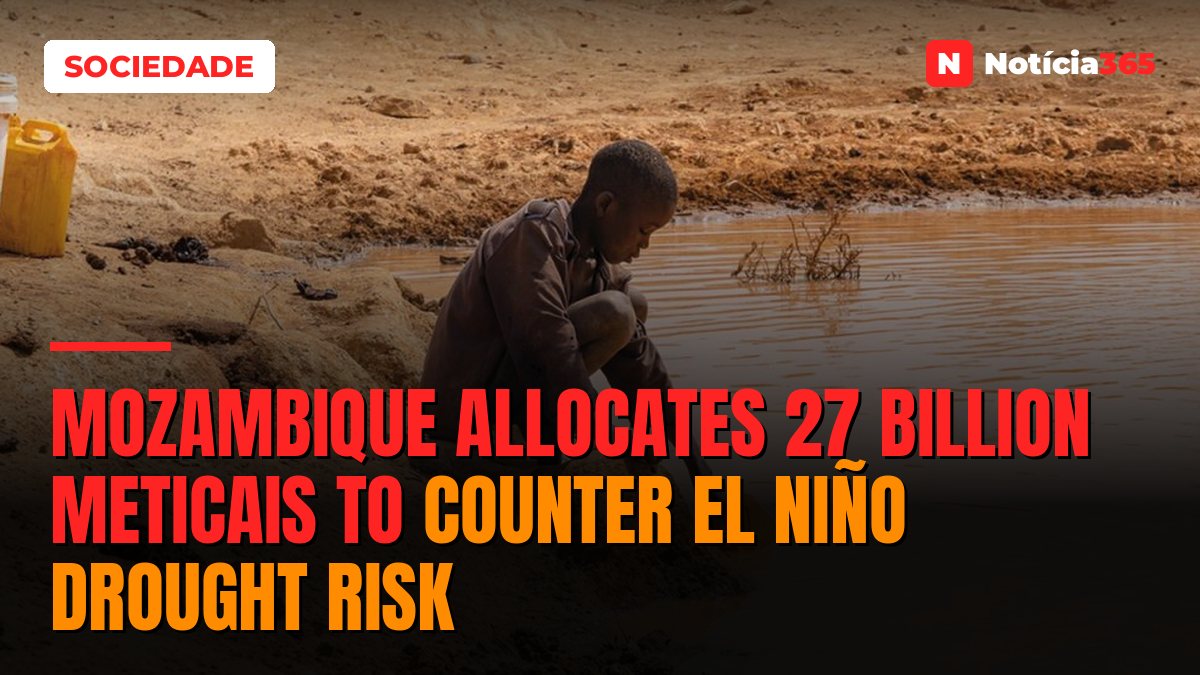

The Mozambican government plans to mobilise approximately 27 billion meticais to finance the National Plan for Mitigating the Impacts of El Niño 2026–2027, designed to support the agriculture, health, education, water supply, food assistance and social protection sectors. The announcement was made on Wednesday, 4 November, in Parliament by Prime Minister Benvinda Levi.
Quoted by the Mozambique News Agency (AIM), Levi explained that forecasts for the 2026–2027 rainy season point to the risk of severe drought in 76 districts across the provinces of Maputo, Gaza, Inhambane, Sofala, Manica and Tete, while Nampula, Cabo Delgado and Niassa are expected to record rainfall within normal ranges.
To minimise the effects of the drought, the government plans to distribute agricultural input kits to more than 185,000 families, construct multipurpose silos to complement small-scale irrigation systems, and build or rehabilitate dams, water supply systems and multipurpose boreholes. Interventions in water infrastructure are expected to benefit more than one million people.
In the health sector, the plan includes reinforcing epidemiological surveillance and building advance stockpiles of medicines and essential supplies, including oral rehydration salts, cholera response kits, antimalarials and rapid diagnostic tests.
A recent study by FurtherMarkets identified Mozambique as one of the most vulnerable countries to the effects of an intense El Niño event among seven sub-Saharan African economies analysed, citing low cereal productivity and heavy dependence on hydroelectric power. The report warns of potential disruptions to agricultural production, food supply, electricity generation and logistics corridors during the 2026–2027 campaign.
Titled ‘El Niño’s Fault Lines in Africa’, the document assesses the exposure of seven African economies to the climate phenomenon based on indicators of agricultural productivity, the weight of agriculture in the economy, hydroelectric dependence and logistics performance.
The study cites forecasts from the United States National Oceanic and Atmospheric Administration (NOAA), which, in its October update, indicated a probability of more than 83% of strong to very strong El Niño conditions occurring through the first quarter of 2027. NOAA also estimated an 83% probability that the phenomenon would reach historic intensity, with temperature anomalies of 2.5 degrees Celsius or above, in the October-to-December 2026 period.
According to data presented in the report, Mozambique recorded cereal productivity of 776 kilogrammes per hectare in 2024, the lowest among the seven countries analysed. Agriculture accounted for 25.6% of gross domestic product (GDP) in 2025, while hydroelectric generation represented 83% of the country’s total electricity output in 2024.
This combination, the report argues, heightens the economy’s exposure to periods of insufficient rainfall, with potential consequences for food production and energy supply.
The document also recalls the effects of the 2015–2016 El Niño, when Mozambique’s maize production fell by approximately 35% year-on-year in 2016. Data from the United Nations Food and Agriculture Organisation (FAO), cited in the study, indicate that the drought affected approximately 864,000 hectares of agricultural land and 459,000 farmers, while flooding affected 194,100 people.
Source: Diário Económico
Original article: https://www.diarioeconomico.co.mz/2026/11/05/economia/desenvolvimento/el-nino-governo-prepara-27-mil-milhoes-de-meticais-para-enfrentar-seca/