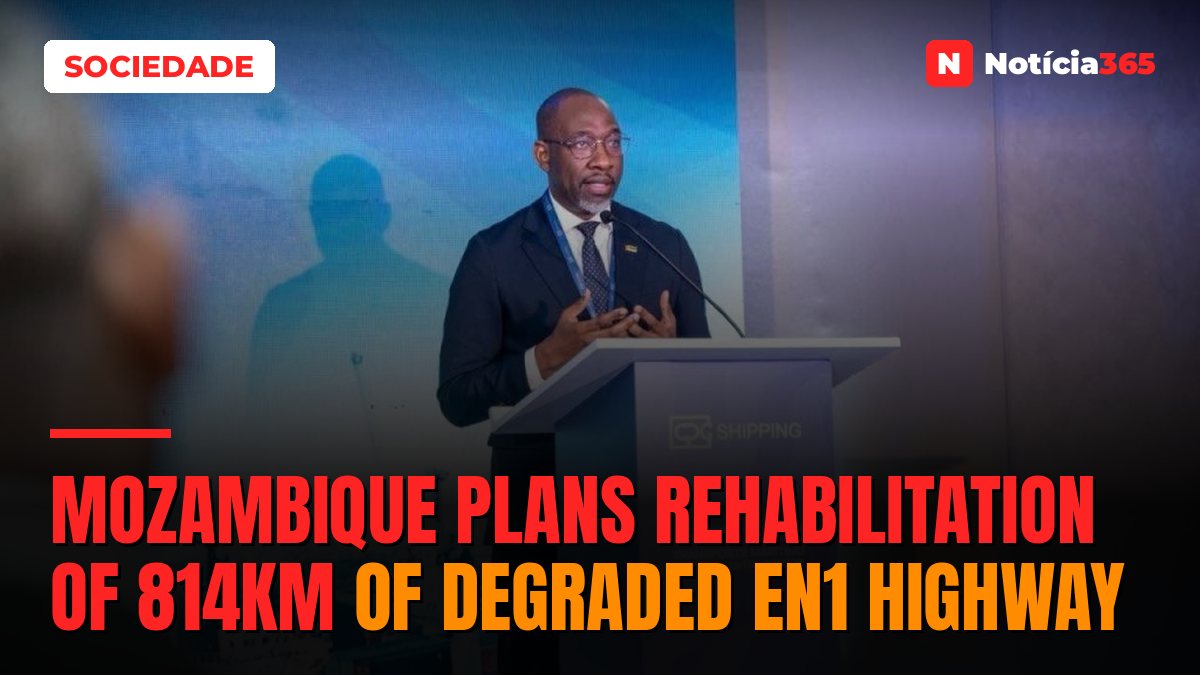

The Mozambican government is preparing a package of interventions to rehabilitate National Road Number One (EN1), of which 814 kilometres are in a state of complete degradation along a total length of 2,620 kilometres. The plan encompasses the reconstruction of the worst-affected sections, the launch of new public tenders, and the award of concessions to private operators, with the aim of improving the movement of people and goods and strengthening the resilience of the country’s main road artery against extreme weather events.
According to Lusa, the announcement was made on Wednesday, 4 November, by the Minister of Transport and Logistics, João Matlombe, during a government question-and-answer session at the National Assembly in Maputo. The minister explained that a government survey had identified 814 kilometres of the EN1 in a state of complete deterioration, requiring structural interventions.
“These sections require structural interventions, including pavement reconstruction, bridge rehabilitation, and improvement of drainage systems,” he said.
In the centre of the country, one of the priorities is the Gorongosa-Caia corridor, where interventions covering approximately 200 kilometres are planned. The government also announced procurement and contracting procedures for two segments of approximately 84 kilometres each.
In the same region, rehabilitation works are planned for the 176 kilometres between Chimuara and Nicoadala — tenders for which have already been launched — as well as the Inchope-Gorongosa section, covering approximately 70 kilometres.
In the south, the government is preparing a tender for the rehabilitation and widening of the Missão Roque-Zimpeto section, spanning 6.7 kilometres, as well as a 17-kilometre intervention between 3 de Fevereiro and Incoluane.
Tenders are also being prepared for the concession and operation of the Marracuene-Xai-Xai and Xai-Xai-Pambara sections, including the Pambara-Rio Save segment.
“These sections require structural interventions, including pavement reconstruction, bridge rehabilitation, and improvement of drainage systems.” — João Matlombe
In the north, the plan provides for the rehabilitation of the 94 kilometres between Pemba and Metoro, as well as an assessment of a concession model for the Nicoadala-Nampula section.
Beyond reconstructing the most degraded segments, the government intends to use concession arrangements to ensure the maintenance of sections still in good or reasonable condition, seeking to prevent their further deterioration and the need for more extensive works.
João Matlombe assured that the government would continue carrying out maintenance works and emergency interventions to keep the route open for people and goods. Among the measures planned is the identification of the points most vulnerable to flooding and traffic disruptions, in order to guide investment priorities and resource mobilisation.
The need to strengthen the EN1’s resilience to extreme weather events became particularly evident during the last rainy season, which was marked by traffic interruptions across several sections. The planned interventions are therefore expected to include improvements to drainage systems, hydraulic structures, and bridge protection.
“The recovery of the EN1 is a national priority,” the minister stressed.
In May 2025, João Matlombe announced that the government had secured US$1.1 billion for the rehabilitation of the road, out of a total estimated need of US$3.5 billion for its full restoration. The financing secured at the time represented approximately 31% of identified requirements.
Source: Diário Económico
Original article: https://www.diarioeconomico.co.mz/2026/11/05/negocios/infra-estruturas/en1-governo-prepara-recuperacao-de-814-quilometros-degradados/