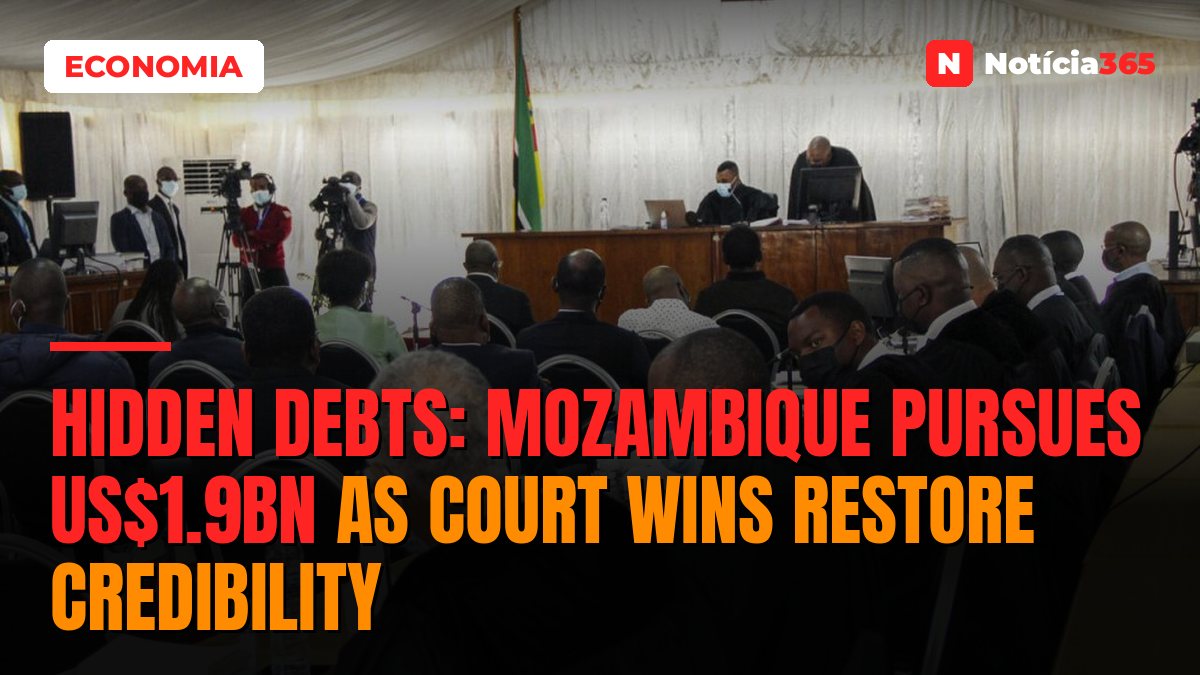

The Mozambican government says successive court rulings in its favour in the hidden debts case are helping to restore the country’s international credibility, and has reaffirmed its commitment to recovering approximately US$1.9 billion in damages.
“The successive court decisions have helped restore Mozambique’s international image and reinforce confidence in the markets. This process caused serious damage to the country’s image,” an official government source told the Lusa news agency.
According to the same source, “the Republic of Mozambique will do everything in its power to recover what is owed to it” — namely, the amounts determined by the courts.
British court keeps Iskandar Safa’s widow in proceedings
The most recent ruling in Mozambique’s favour came on 21 October, when the Court of Appeal of England and Wales rejected an appeal by Clara Martinez Thedy de Safa, widow of Iskandar Safa, founder of the Privinvest group, and upheld the lower court’s decision to include her in the case brought by the state.
The ruling, which remains subject to further appeal, paves the way for the execution of assets from Iskandar Safa’s estate, in addition to those of Privinvest group companies, in satisfaction of the 2024 judgment in Mozambique’s favour.
Safa died in January 2024, and his children renounced their inheritance, prompting the state to seek the inclusion of his widow in the proceedings.
Mozambique’s legal team, led by the Attorney General’s Office, described the appeals as manoeuvres intended to delay compliance with the court’s decision.
“The facts are established and provide for payment,” a member of the legal team told Lusa, adding that the principal judgment has become final and has consolidated the obligation to compensate the state, recognising Mozambique as a victim of a fraudulent banking scheme.
“The successive court decisions have helped restore Mozambique’s international image and reinforce confidence in the markets. This process caused serious damage to the country’s image” — Government source
Privinvest ordered to pay approximately US$1.9 billion
In July 2024, the London Commercial Court ordered the Privinvest group to pay Mozambique approximately US$1.9 billion in damages. In his judgment, Justice Robin Knowles concluded that Iskandar Safa and companies within the group participated in the corruption of Mozambican officials, including former Finance Minister Manuel Chang, to secure the issuance of state guarantees that underpinned the loans.
Manuel Chang has since been convicted in the United States in connection with the same case. An appeal filed by Privinvest companies against the London judgment was dismissed after they failed to pay the security deposit required by the Court of Appeal, rendering the decision against those entities final.
From the total compensation amount, US$400 million is expected to be deducted, corresponding to assets Mozambique has already recovered.
Settlements with banks cut creditor claims by 84%
Alongside the court proceedings, Mozambique has reached out-of-court settlements with several banks involved in the case, including Portuguese lender BCP, in 2023 and 2025.
These agreements have reduced the state’s exposure to bank claims from US$1.4 billion to US$220 million — a reduction of 84% in the value claimed and 66% of the principal.
For the government, the settlements and favourable court decisions represent important steps towards rebuilding the country’s credibility with markets and creditors, nearly a decade after the scandal first came to light.
Hidden debts triggered Mozambique’s financial crisis
The case originated in loans totalling more than US$2 billion extended between 2013 and 2014 by Credit Suisse and VTB to state-owned companies Proindicus, EMATUM, and MAM. The financing was guaranteed by the Mozambican state without the knowledge of parliament or international partners.
The disclosure of the debts in 2016 triggered a severe financial crisis, prompting several donors to suspend direct budget support and contributing to the country’s sovereign debt default.
Source: Diário Económico
Original article: https://www.diarioeconomico.co.mz/2026/11/05/economia/dividas-ocultas-governo-diz-que-decisoes-judiciais-ajudam-a-recuperar-credibilidade-do-pais-e-insiste-em-reaver-19-mm/