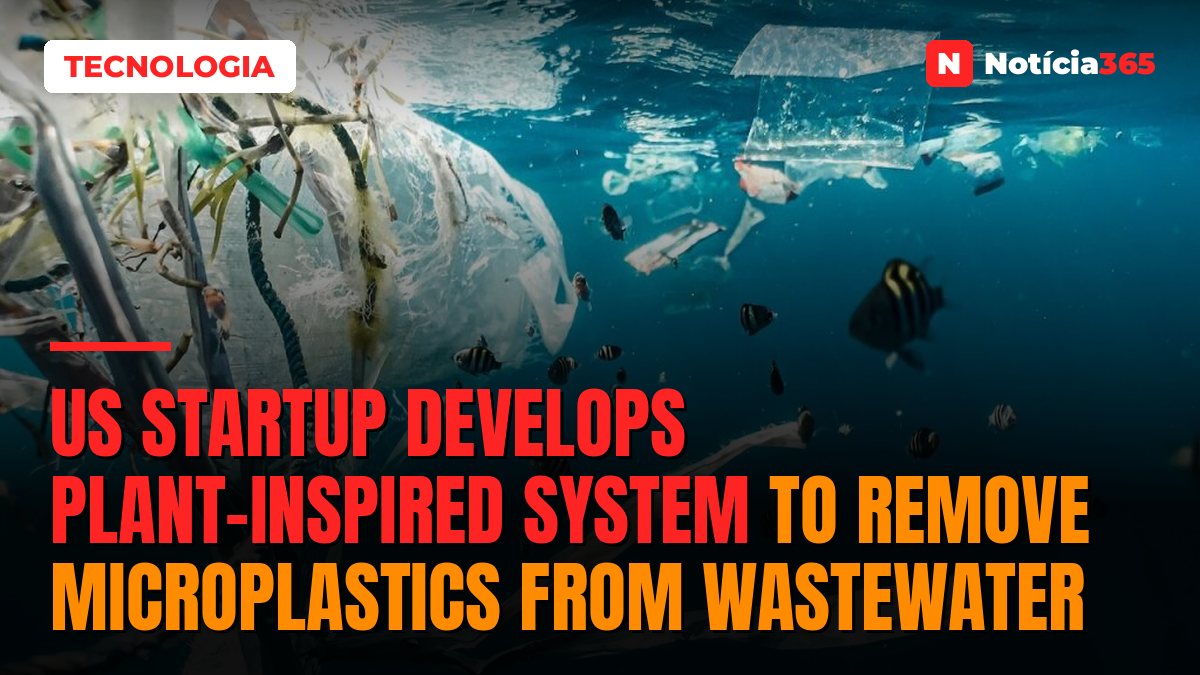

US startup PolyGone Systems has developed a technology capable of removing microplastics from wastewater before it is discharged back into the environment. The equipment uses a material inspired by the properties of hydrophobic plants — which naturally repel water — to attract and capture plastic particles.
The system was developed by Nathanial Banks and Yidian Liu, former students at Princeton University. It will undergo a two-year evaluation to determine its effectiveness at commercial scale. The equipment allows water to pass through while retaining microplastic particles, which are then collected and directed to recycling facilities.
In laboratory tests, the prototype removed 98% of microplastic particles present in wastewater. The pilot programme aims to verify whether this level of efficiency can be sustained under real operating conditions and with larger volumes of water.
The initiative is being implemented in partnership with the Atlantic County Utilities Authority (ACUA), which regards the removal of these contaminants as important for environmental and public health protection. According to the authority, while there is currently no federal regulation in the United States requiring wastewater operators to eliminate microplastics, solutions must be developed to reduce their dispersal.
Microplastic particles reach wastewater through a variety of sources, including laundry washing, stormwater runoff, and improper waste disposal. Many treatment plants were designed to remove sewage, solid matter, heavy metals, and other conventional pollutants, and are not specifically equipped to eliminate microplastics.
Matt DeNafo, president of the ACUA, warned that returning wastewater to the ocean without removing these particles contributes to their accumulation in the environment and in the food chain.
For Nathanial Banks, co-founder and chief executive of PolyGone Systems, the initiative represents an opportunity to develop large-scale treatment systems with low energy consumption and reduced material use. He noted that the technology could serve as an alternative to strengthen conventional wastewater treatment processes, though its effectiveness, operating costs, and capacity for continuous operation at commercial scale remain to be assessed during the pilot programme.
Source: Diário Económico
Original article: https://www.diarioeconomico.co.mz/?p=558079