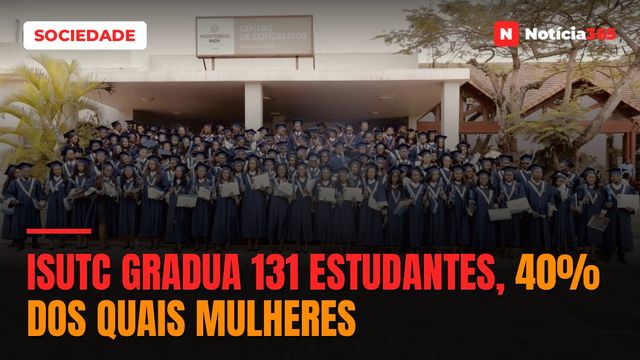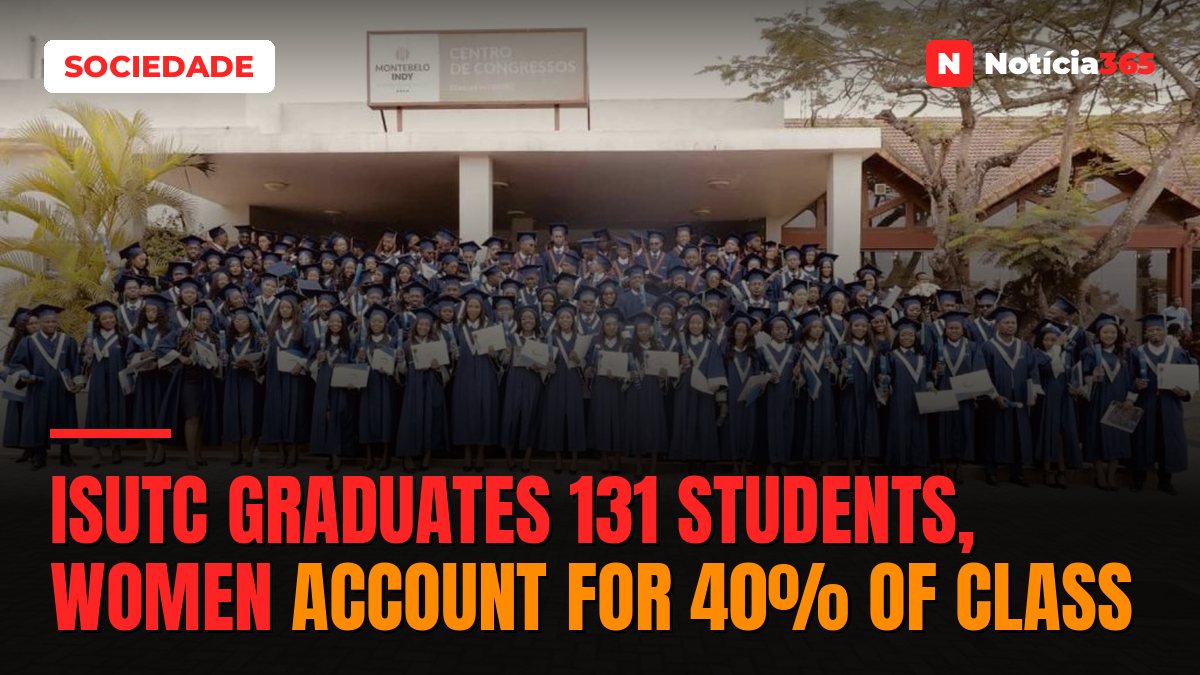

The Instituto Superior de Transportes e Comunicações (ISUTC) graduated 131 students on 31 October in Maputo — 127 at undergraduate level and four at master's level — in a ceremony at which the government highlighted the institution's contribution to training women in engineering and promoting gender equality in higher education.
Of the total graduates, 52 are women, representing 40% of the class, according to a statement issued by the institution. The female representation was specifically noted by Lúcia da Silva, National Director of Science, Technology and Innovation, who spoke on behalf of the government and the Ministry of Education and Culture. "In engineering, women represent one third of graduates. In Electrical Engineering, equal numbers of women and men are graduating today; in Electronic and Telecommunications Engineering, three or four graduates are women; and in Management courses, women account for more than 70%," da Silva said.
She also noted that the top academic result of the ceremony — a final average of 18 out of 20 — was achieved by a female student, adding that "talent and merit know no gender barriers." Over the past seven years, ISUTC has produced more than 1,100 undergraduate graduates. According to the institution's director-general, José Leopoldo Nhampossa, the number of undergraduate students has grown 134% since 2015, bringing the cumulative total to 2,541 graduates.
"Around 98% of our graduates are already employed or completing internships, and we have approximately 90 partner companies and institutions," Nhampossa said, adding that since its founding, ISUTC has aligned its curricula with market needs to ensure that training responds to the demands of different sectors.
Luís Almeida, managing director of Transcom, the founding entity of ISUTC, credited the students for the results achieved and urged the newly graduated cohort to transform the skills acquired into opportunities and solutions to Mozambique's challenges.
"That is the responsibility we invite you to take on: carry with you the rigour, integrity, sense of responsibility and commitment to quality that we seek to cultivate at ISUTC. Your path will be defined by what you know how to do, but also by how you treat others and the choices you make," Almeida said, adding that the diploma should also serve as an incentive for continuous learning.
The graduates expressed satisfaction at completing their studies and stated their readiness to apply the knowledge acquired in service of the country's development.
ISUTC is a private higher education institution founded in 1999, with a mission to train professionals with scientific, technical and human competencies, prepared to meet the needs of the labour market and contribute to Mozambique's socioeconomic development.
Source: Diário Económico
Original article: https://www.diarioeconomico.co.mz/?p=558248