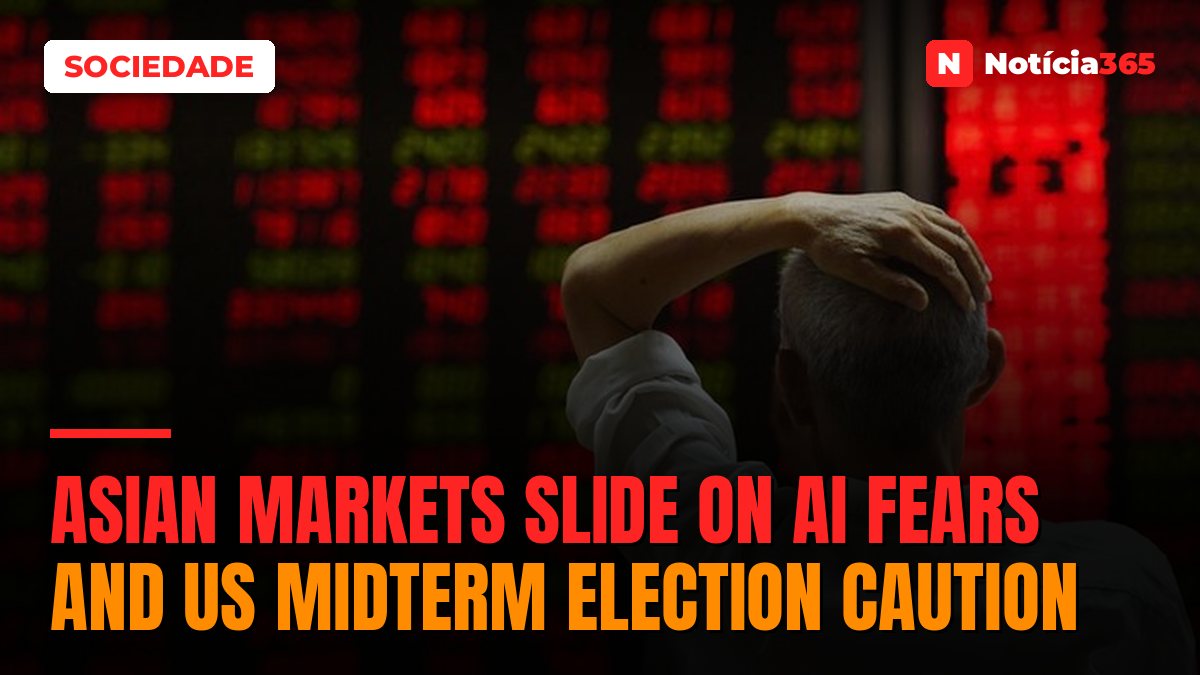

Major Asian equity indices closed broadly lower on Tuesday, pressured by a sell-off on Wall Street in the previous session and rising investor caution ahead of the United States midterm elections.
Japanese markets were closed for a national holiday. In China, Hong Kong’s Hang Seng index edged up 0.41%, while the Shanghai Composite fell 0.82%. Taiwan’s TWSE declined 3.59%, and South Korea’s Kospi shed an identical 3.59%.
The sharp declines in Taiwan and South Korea — markets with heavy exposure to artificial intelligence-linked stocks — came after a US semiconductor manufacturer index extended a losing streak to three consecutive sessions, accumulating a decline of 12%. The Nasdaq 100, meanwhile, retreated more than 10% from its all-time high, entering technical correction territory. Futures for US and European equity markets were also trading lower on Tuesday morning.
In line with the broader sell-off, both Samsung Electronics and SK Hynix fell more than 4%.
Chinese equities retreated despite the country’s central bank announcing it would encourage financial institutions to make greater use of stock market support instruments and to optimise the related conditions, in an effort by authorities to reinforce market stability.
“Markets are predominantly in a risk-off environment, against a backdrop of growing concerns over AI and the US midterm elections,” Kieran Calder, head of Asian equity research at Union Bancaire Privée, told Bloomberg. “We have analysed every US midterm election since 1950 and found that the S&P 500 was always higher six months later. If this trend holds, we expect markets to rally by year-end, although this could be a volatile week,” he added.
Also weighing on investor sentiment, Brent crude oil rose during Asian trading hours after plunging nearly 8% on Monday, as both the United States and Iran signalled willingness to pursue peace negotiations while the Middle East conflict enters its ninth month.
Source: Diário Económico
Original article: https://www.diarioeconomico.co.mz/2026/11/03/mercados/mercados-mercados/asia-perde-terreno-com-pressao-da-ia-e-eleicoes-intercalares-nos-eua/