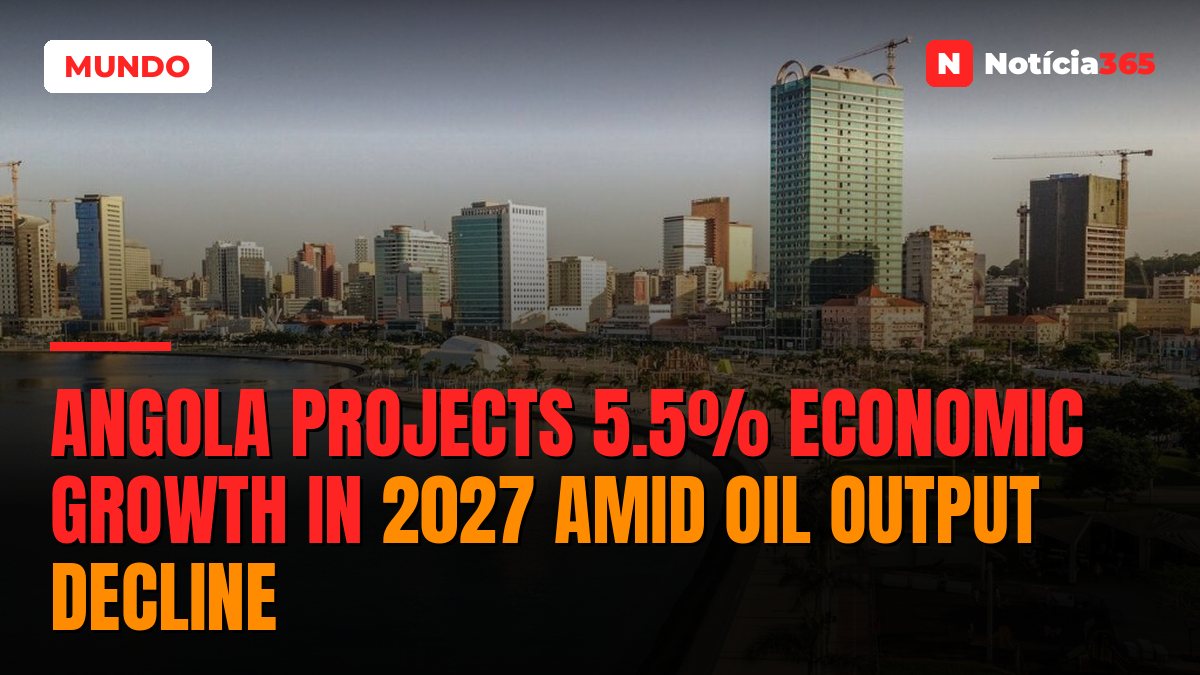

The Angolan government is projecting economic growth of 5.5% in 2027, driven primarily by expansion in non-oil sectors that is expected to offset declining crude production and elevated debt-service costs. The target is set out in the proposed General State Budget (OGE) for 2027, which has been drawn up on the basis of an average oil price of US$71 per barrel.
According to government projections, non-oil sectors are forecast to grow by 7.2%, while oil production is expected to contract by 3.8%. The estimates reflect a strategic emphasis on economic diversification, with greater reliance on non-oil activities to sustain growth at a time when crude output continues to decline.
In 2027, crude oil production is expected to average approximately one million barrels per day, a reduction of around 50,000 barrels per day compared with the more than one million barrels projected for 2026. This decline underscores the growing importance of non-oil sectors — including manufacturing, communications, and trade — to the performance of the Angolan economy.

According to an analysis by Further Africa, these sectors helped drive economic activity in the first half of 2026, based on World Bank data. In the first quarter of the same year, Angola's gross domestic product (GDP) recorded year-on-year growth of 5.3%, reflecting the contribution of non-oil activities to the broader economic expansion.
The country's growth trajectory points to a gradual acceleration, following GDP growth of 3.1% in 2025 and a projected expansion of 4.5% in 2026. The government's 2027 target of 5.5% surpasses the 3.3% previously forecast by external observers for the same period.
In financial terms, the proposed budget is valued at approximately US$40.9 billion. Gross financing requirements stand at around US$16.1 billion, of which more than US$9 billion is earmarked for debt repayment. This debt-service burden significantly narrows the fiscal space available for new public investment.
Against this backdrop, the government is projecting a fiscal deficit equivalent to approximately 4.11% of GDP. Despite the positive growth outlook, the heavy weight of debt servicing makes fiscal discipline a key determinant of the country's credit prospects. In the meantime, a potential easing of inflation could improve planning conditions for companies in non-oil sectors, provided it is accompanied by exchange rate stability and controlled management of public expenditure.
The proposed 2027 OGE is still subject to parliamentary review and may be amended before final approval. Until that point, investors are advised to monitor the final version of the document, the trajectory of oil prices, Sonangol's production forecasts, and the capacity of non-oil sectors to deliver the 7.2% growth the government has targeted.
Source: Diário Económico
Original article: https://www.diarioeconomico.co.mz/2026/11/02/mundo/angola/angola-governo-preve-crescimento-economico-de-55-em-2027/