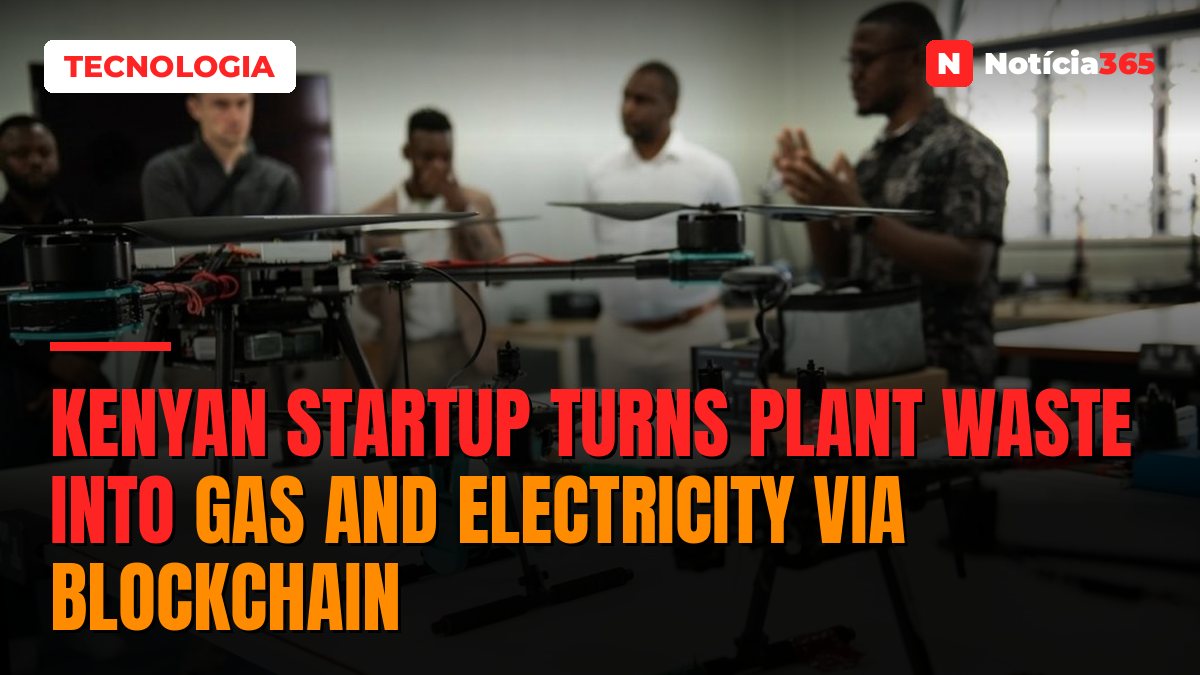

Kenyan startup Autonomous Systems Research (ASR) has developed a technology capable of converting plant waste into gas and electricity, using blockchain — a system that allows digital information and transactions to be recorded and shared securely and transparently, with changes impossible to make without leaving a trace — to track biomass origins, register payments to suppliers, and monitor energy production.
The initiative, which aims to expand energy access in rural communities, grew out of an operational necessity. ASR conducts drone operations in remote areas to support environmental conservation, wildlife protection, and disaster response planning. According to ASR founder Moses Gichanga, transporting fuel to those locations became unsustainable, prompting the team to explore alternatives based on biomass.
The startup has developed equipment capable of converting plant residues into gas, which is then used to power engines and generate electricity. Among the biomass sources being considered are residues from the pruning of coffee plants — an approach that avoids the felling of trees or incentivising the replacement of food crops with energy crops.
The initiative includes a blockchain-based traceability component that records the origin of the biomass, the type and quantity of material collected, authorisations for its removal, payments made to suppliers, and the volume of gas produced. The system is also linked to payment mechanisms through mobile money platforms, including M-Pesa and Airtel Money.
ASR is also evaluating the possibility of involving rural primary schools in the project, assessing the use of the gas for cooking meals and heating water, provided adequate safety, ventilation, and supervision conditions can be guaranteed.
Despite the progress made, commercial expansion faces technical challenges. ASR has not yet developed a gas liquefaction method that is sufficiently energy-efficient. At present, the fuel is stored without undergoing liquefaction, which occupies more space and limits the capacity for large-scale distribution.
The company believes liquefaction could facilitate cylinder storage and commercial distribution of the gas, but acknowledges that any solution will require significant investment in research and development. Beyond the energy sector, ASR is exploring additional blockchain applications, including a platform to provide mobile money services and a system to register disaster survivors and their needs. The latter has not yet been tested in real-world situations.
According to the Tech Africa News portal, ASR received its first funding from the UNICEF Office of Innovation through the Blockchain Ventures programme, supported by the Ethereum Foundation and the GSR Foundation. The backing allowed the startup to explore drone applications in environmental conservation, agriculture, and emergency response planning, while also facilitating access to capacity-building programmes and new funding opportunities.
ASR intends to advance its projects through the research and testing phase before establishing independent companies to commercially exploit solutions that prove viable. According to Gichanga, the objective is to combine financial sustainability with social impact — making energy more accessible and creating economic opportunities for the communities involved.
Source: Diário Económico
Original article: https://www.diarioeconomico.co.mz/?p=553852