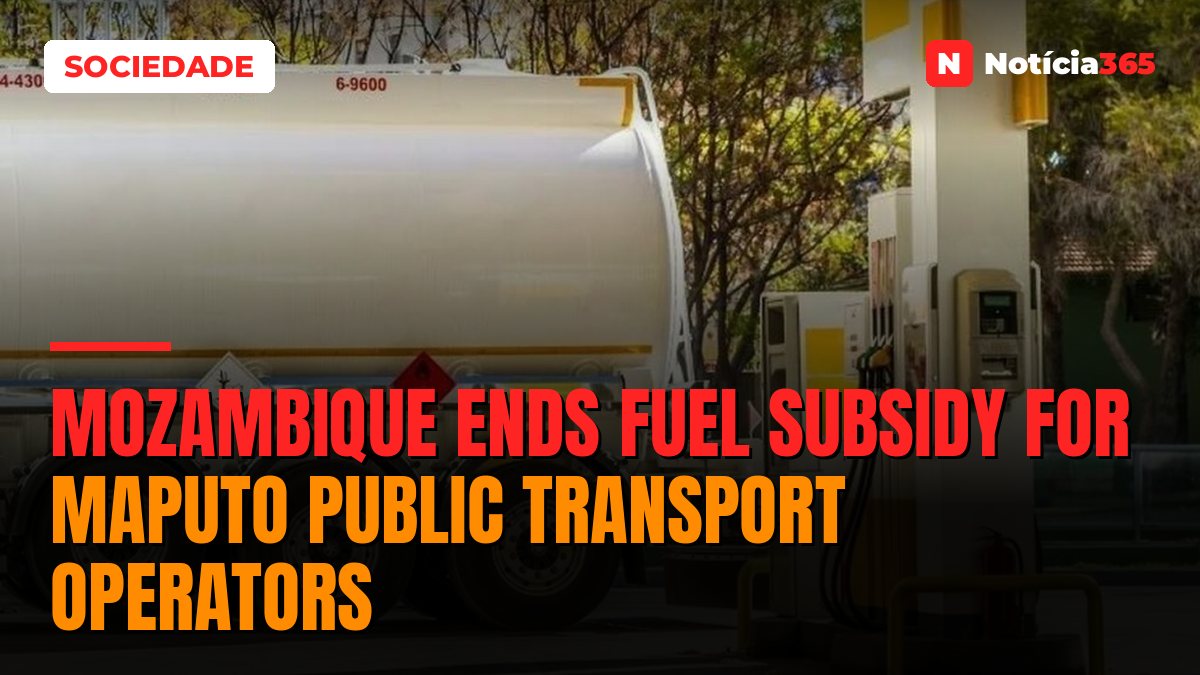

The Mozambican government has decided to terminate fuel subsidy payments designed to offset operating costs for public passenger transport operators in the Maputo Metropolitan Region. The measure comes after three months of implementation, during which the state disbursed more than 307 million meticais. Concerns are already mounting over a possible increase in passenger fares.
The decision covers operators providing services across the municipalities of Maputo, Matola, Boane, Marracuene, Matola-Rio, Manhiça, and Namaacha, where the compensation mechanism had been introduced to cushion the sector against rising fuel prices.
According to Alberto Matusse, national director of Transport and Safety, quoted by the newspaper Domingo, the programme was an extraordinary and temporary measure, initially designed to run for three months. “After three months, the government studied the situation and concluded that more sustainable mechanisms exist for managing public passenger transport, particularly in urban areas,” he explained.
The compensation mechanism, announced in May, provided monthly payments of 35,000 meticais to operators of 15-seat vehicles, 60,000 meticais to 35-seat vehicles, and 141,000 meticais to bus operators. Over the three-month period, the government disbursed a total of 307 million meticais. In the first month, 2,476 vehicles were covered, with payments totalling approximately 126.7 million meticais.
In the second month, the number of beneficiaries rose to 2,565 vehicles, corresponding to expenditure of 122.2 million meticais. In the final month, payments totalled 58.1 million meticais, distributed among 847 vehicles.
The suspension of the scheme marks the end of a direct financial intervention by the state aimed at easing the burden on transport operators, at a time when operators continue to cite fuel prices, vehicle maintenance, and other operational costs as the principal threats to the sector’s viability.
The government’s decision has not been well received by public transport operators, who are pushing for a fare revision as an alternative means of compensating for the end of subsidies. The Mozambican Federation of Road Transport Associations (FEMATRO) has submitted a proposal for fare increases of between 10 and 12 meticais on current rates within the Maputo Metropolitan Region.
According to the organisation’s spokesperson, Jorge Manhiça, the proposal envisages raising the current 15-meticais fare to 25 meticais, and the 18-meticais fare to 30 meticais. He explained that operators had initially proposed an increase of 20 meticais but scaled back their demands following negotiations with metropolitan authorities.
The Maputo Metropolitan Agency, however, is advocating more moderate increases of between three and five meticais, in order to minimise the financial impact on passengers. The agency’s administrator, Afonso Jamisse, clarified that no final decision on new prices has been reached, as consultations with the municipalities covered by the metropolitan transport system are still under way. “We listened, but we did not accept the proposal,” Jamisse said, adding that fare approval falls under the jurisdiction of the Metropolitan Agency, subject to an opinion from the Maputo Metropolitan Council.
Despite the absence of an official decision on fare adjustments, FEMATRO is seeking to have new prices take effect on 1 November. The organisation has warned that if its proposals are not accepted, public transport services in the Maputo Metropolitan Region could face disruptions from 2 November, arguing that operators are facing financial difficulties in sustaining operations.
The Maputo Metropolitan Agency, for its part, clarified that it has made no commitment regarding the introduction of new fares in November, stressing that any decision must result from the consultations currently under way. According to Afonso Jamisse, any fare change should be announced with ten to fifteen days’ notice, allowing passengers and operators time to prepare.
The end of the fuel compensation scheme thus presents fresh challenges for the management of public transport in the Maputo Metropolitan Region, as authorities seek to balance the financial sustainability of operators with the need to protect passengers’ ability to pay.
Source: Diário Económico
Original article: https://www.diarioeconomico.co.mz/2026/10/20/desenvolvimento-2/governo-acaba-com-compensacao-dos-combustiveis-nos-transportes-publicos/