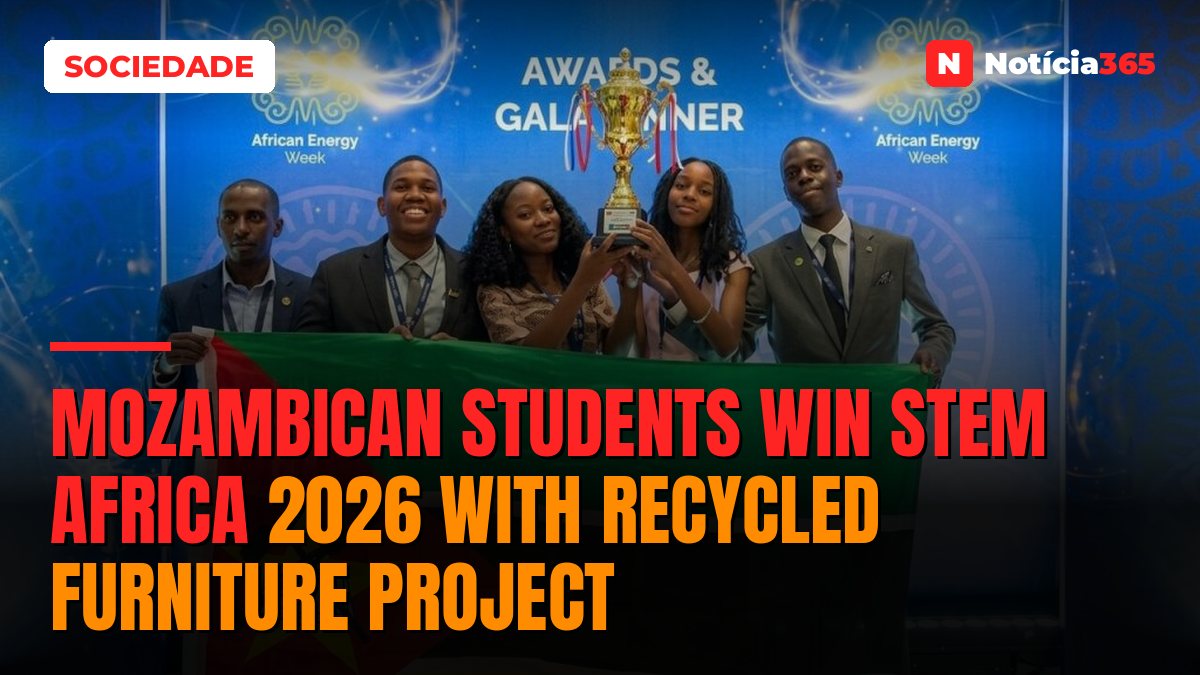

The Mozambican team Mentes Brilhantes has won first place at the ExxonMobil Foundation STEM Africa Challenge 2026 in Cape Town, South Africa, with a project called Ecocarteiras. The initiative transforms plastic waste and sawdust into school furniture, addressing both waste accumulation and a shortage of desks in classrooms.
The students from Escola Comunitária Nossa Senhora do Livramento T.3, in Matola, represented Mozambique in the final held during African Energy Week 2026. The competition brought together 16 finalists from Angola, Mozambique, Namibia, and Nigeria, selected from more than 9,600 participants across the four countries.
The project combines recycled plastics — specifically high-density polyethylene (HDPE) and polypropylene (PP) — with discarded sawdust to produce school desks and chairs. According to the team’s presentation, the furniture was designed to be resistant to water and termites.
The proposal is built on the reuse of materials and seeks to reduce the consumption of new timber. By converting waste into furniture, the students aim to provide an alternative means of equipping classrooms while simultaneously reducing waste.
Second place went to the Angolan team IXIETU, which presented an artificial intelligence-supported soil diagnosis and recovery system designed to help farmers improve land fertility.
Nigeria’s Nexora Nexus Inventors finished third with the Solar Hydro Smart Grid, which combines solar energy, hydroelectric storage, batteries, and control systems. In fourth place, the Namibian team Aqua Volt presented a solution to collect floodwaters and purify them, aiming to ensure access to drinking water during dry periods.
Promoted by the ExxonMobil Foundation in partnership with Junior Achievement Africa, STEM Africa develops skills in science, technology, engineering, and mathematics. The programme also incorporates artificial intelligence and challenges students to apply their knowledge to solving problems within their communities.
In Mozambique, the 2026 edition was launched on 12 June at the Faculty of Natural Sciences and Mathematics of the Universidade Pedagógica de Maputo, with plans to reach more than 500 students from 21 schools across Maputo, Matola, and Marracuene.
The path to the final included scientific knowledge tests, regional competitions, and a national innovation camp. Prior to the presentation in South Africa, the winning teams from the national stages received mentoring from ExxonMobil professionals to refine their proposals and prepare their defence before the judges.
Source: Diário Económico
Original article: https://www.diarioeconomico.co.mz/2026/10/19/trends/new-ways/estudantes-mocambicanos-conquistam-primeiro-lugar-no-stem-africa-2026/