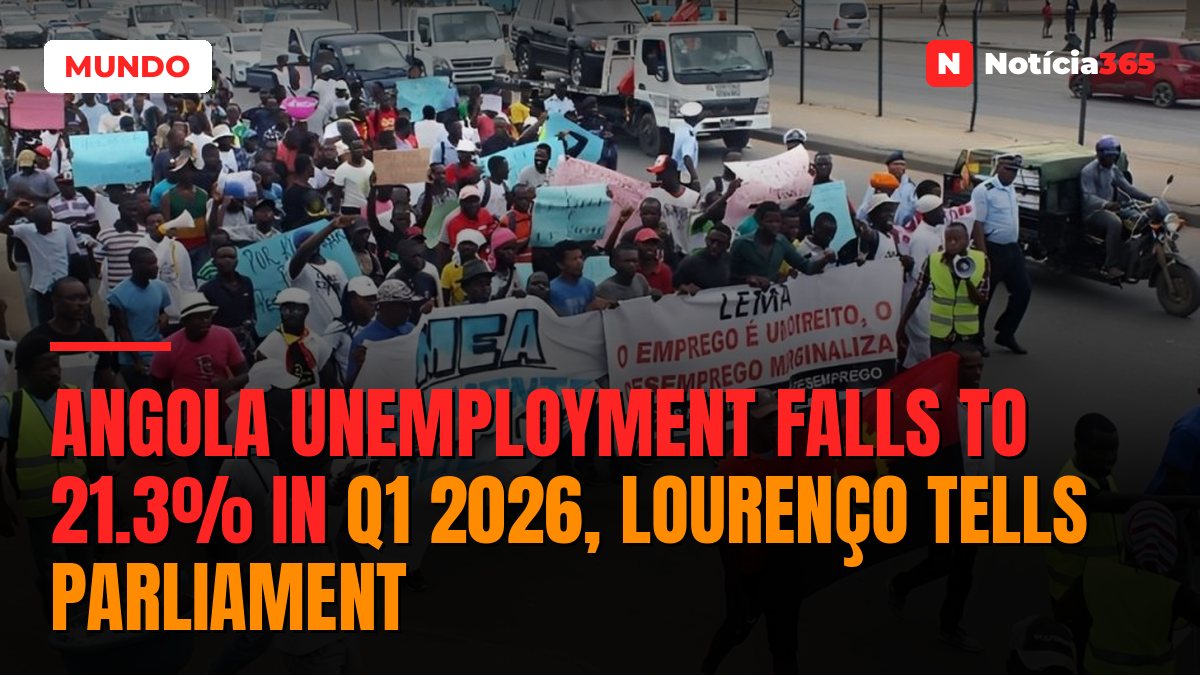

Angola's unemployment rate fell from 31.5% in 2024 to 21.3% in the first quarter of 2026, a decline of 10.2 percentage points. The figures were presented on Thursday (15) by President João Lourenço during his State of the Nation address to the National Assembly in Luanda.
The drop in the unemployment rate marks an improvement in the indicator relative to 2024. However, data from the National Statistics Institute (INE) show that millions of people remain without work and that significant disparities persist between men and women, as well as between urban and rural areas.
According to INE, Angola had approximately 9.56 million employed persons aged 15 and over in the first quarter of 2026. During this period, the employment rate — defined as the share of the working-age population in employment — stood at 42.3%.
The distribution of employment reveals marked differences between urban and rural areas. In urban zones, the employment rate reached 50.9%, while in rural areas it stood at 23.7%. By gender, the rate was 45.6% among men and 39.2% among women.
Despite the reduction in the unemployment rate announced by Lourenço, the number of people without work remains high. INE estimated the total number of unemployed persons aged 15 and over at approximately 2.59 million in the first quarter of 2026.
Women continue to record a higher unemployment rate than men. According to INE data, the indicator stood at 23.4% among women, compared with 19.3% among men — a gap of 4.1 percentage points.
Young people also face significant barriers to labour market access. In the first quarter of 2026, the employment rate among the 15-to-24 age group was 21%, according to INE, indicating that only a fraction of this cohort was in employment.
The data presented by Lourenço and the INE indicators allow for an assessment of the trajectory of Angola's labour market. While the unemployment rate has declined, the number of people without work and the persistent disparities in employment access show that challenges remain, particularly among women and young people.
Source: Diário Económico
Original article: https://www.diarioeconomico.co.mz/?p=552819