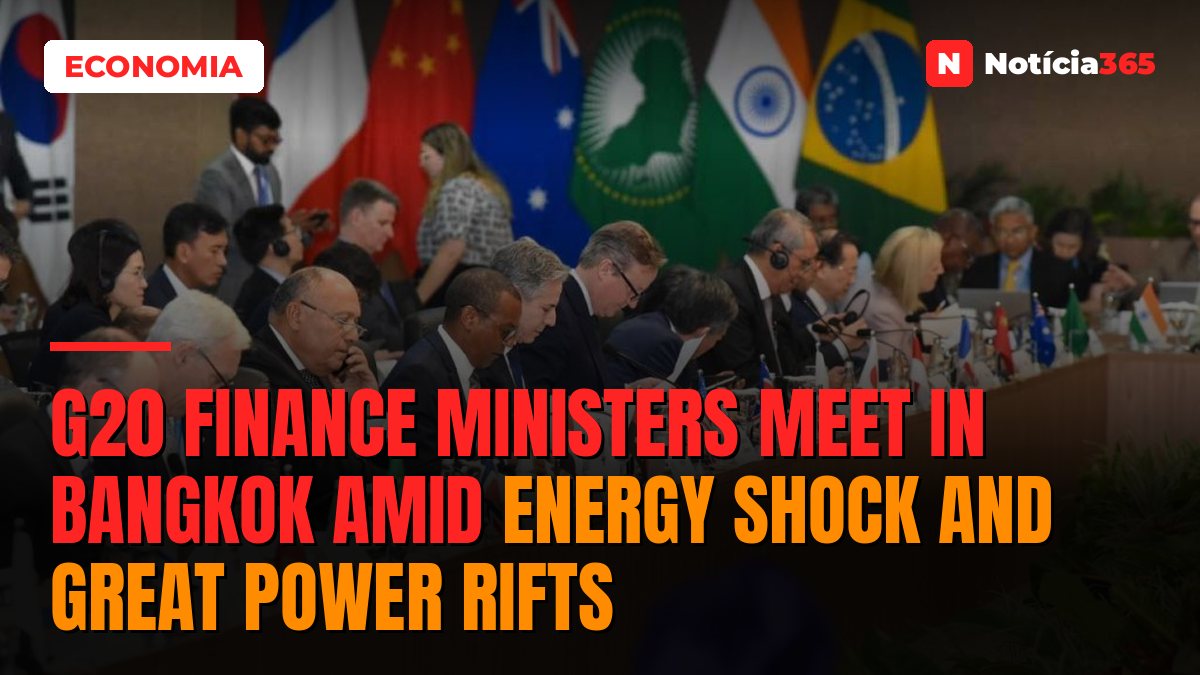

Finance ministers and central bank governors from the G20 met on Thursday, 15 October, in Bangkok, Thailand, against a backdrop of rising economic uncertainty driven by the energy shock triggered by the war in the Middle East and deepening divisions among the world's leading powers.
The meeting, held under the United States presidency, takes place after the International Monetary Fund (IMF) warned of renewed risks to the global economic outlook.
The gathering is being held on the sidelines of the IMF and World Bank annual meetings and represents the final ministerial session of the G20 ahead of the heads of state and government summit, scheduled for 14 and 15 December in Miami, in the United States.
Two days before the meeting, the IMF revised upward its forecast for global economic growth in 2026, from 3% to 3.1%, while keeping its 2027 estimate unchanged at 3.4%. Despite the improvement, the institution cautioned that the global economy remains exposed to the effects of the Middle East conflict, which has driven a sharp rise in energy prices and intensified inflationary pressures.
According to the Fund's projections, global inflation is expected to reach 4.7% in 2026, up from 4.1% recorded the previous year.
The IMF report also identifies a growing concentration of economic growth. Currently, just 32 economies account for 95% of global expansion, down from 54 in the April assessment.
IMF Chief Economist Silvana Tenreyro warned that the resilience the global economy has demonstrated in the face of recent shocks may be approaching its limits, particularly in a context of elevated public debt, persistently high energy costs, and reduced fiscal capacity among governments.
Under the US presidency, the G20 has defined its priorities as economic growth, modernisation of financial regulation, reduction of global imbalances, debt transparency and restructuring, and improvement of cross-border payments.
US Treasury Secretary Scott Bessent has argued that the group should return to its 'core mission' of promoting economic growth, with an emphasis on financial cooperation and market stability.
The meeting is taking place, however, in an atmosphere of disagreement among key members. At the gathering held at the end of August and early September in Asheville, North Carolina, participants failed to reach consensus on a joint communiqué.
According to Bessent, 19 of the 20 members present supported the declaration proposed by the US presidency, with China being the only country to object.
Washington has criticised the trade imbalances associated with the Chinese economy, with Bessent describing the country's external surplus as 'unsustainable'. Differences extend to sanctions policy and responses to international conflicts, including the war involving Iran and its effects on global energy supply.
A further source of tension is South Africa's absence from meetings organised under the US presidency. Despite having chaired the G20 in 2025, Pretoria was not granted accreditation to participate in this year's gatherings, amid a deterioration in diplomatic relations with Washington. The move follows accusations by Donald Trump that the South African government is permitting the persecution of white farmers — allegations rejected by Pretoria.
South African Finance Minister Enoch Godongwana described the situation as a 'temporary setback', expressing hope that the country's participation would resume in 2027, when the United Kingdom assumes the presidency of the group.
The exclusion has drawn criticism and raised concerns about the G20's representativeness, though the African Union continues to participate as a permanent member.
The group comprises 19 countries, the European Union, and the African Union, representing approximately 85% of global gross domestic product, 75% of international trade, and two-thirds of the world's population.
The Bangkok meeting represents an opportunity to discuss coordinated responses to inflation, indebtedness, and growth risks, at a time when political divisions are making it increasingly difficult to build consensus among the world's largest economies.
Source: Diário Económico
Original article: https://www.diarioeconomico.co.mz/?p=552725