
Welding is emerging as one of the primary tools for strengthening local content in Mozambique’s large-scale projects, as foreign labour continues to fill technical roles that certified national professionals could perform.
Welding is present in virtually every major modern infrastructure. From pipelines and energy platforms to power stations, bridges, railways and vessels, this technical speciality forms one of the foundations on which industrial development rests. Without a skilled workforce and adequate certification systems, guaranteeing quality, safety and competitiveness in large-scale projects becomes extremely difficult.
In Mozambique, where substantial investments are under way in the oil and gas, mining, energy and infrastructure sectors, welding is increasingly viewed as an essential tool for advancing local content. The training and certification of national welders could enable greater participation by Mozambican workers and companies in the value chains of these ventures, reducing dependence on foreign labour and increasing the retention of wealth in the country.

New Local Content Law Strengthens National Participation
The recent approval of the Local Content Law represents an important step towards increasing the presence of national companies in natural resource value chains, according to the Minister of Mineral Resources and Energy, Estêvão Pale. He explains that the government’s objective is to ensure that citizens are no longer mere bystanders. “Our local content law introduces elements that should contribute to building local capacity and participation in investment projects. It is essential to invest in developing technical skills in strategic areas such as welding, industrial fabrication and engineering,” he said.
“Around 20 Mozambicans are expected to receive welding training, including a capacity-building period in Portugal and concrete prospects for integration into the labour market.”
The same vision is shared by the president of the Industrial Association of Mozambique (AIMO). “More than a technical profession, welding is an essential competency for industrial development,” he stated.
The business leader considers that current investments in natural gas, mining and energy represent a historic opportunity to accelerate Mozambique’s industrialisation. However, he warned that this opportunity will only produce lasting results if there is a serious commitment to developing local capabilities.
Certification Seen as a Competitiveness Factor
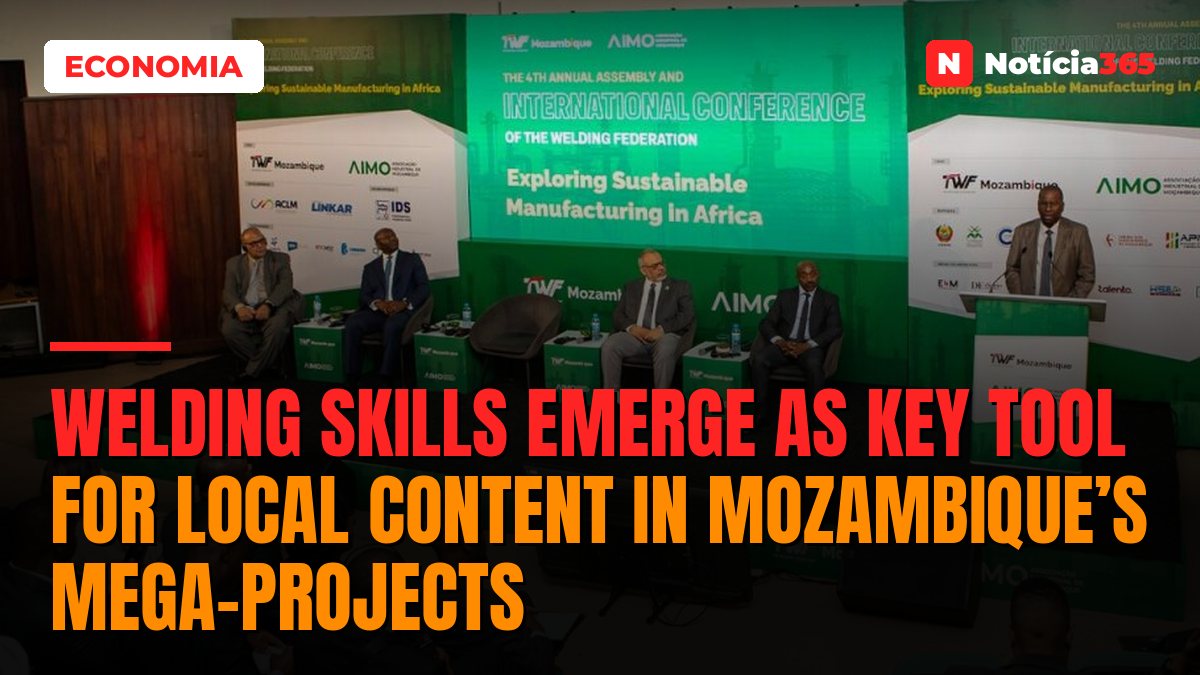
One of the key concerns raised during the 4th Annual Assembly and International Conference of The Welding Federation (TWF), held in Maputo, was the need to align professional training with international standards. “It is not enough to certify products. We must also certify people. This is the mechanism that brings confidence and credibility to our institutions, our professionals and the market,” said Chibanga.
For AIMO, strengthening the certification ecosystem will allow national companies to access larger contracts in the extractive and industrial sectors. The association also considers that improving the quality of production processes could reduce costs, increase competitiveness and raise local participation in major investment projects.
TWF Mozambique and Mobility Programme Invest in Training
One of the landmark moments of the event was the official launch of TWF Mozambique, a structure intended to promote cooperation between industry, educational institutions and professionals in the field. Alongside this, a Mobility and Employment Programme was presented, developed in partnership with the Centre for Professional Training in Metallurgy and Metalworking and Portuguese institutions. The initiative provides for the initial training of around 20 Mozambicans in welding, including a capacity-building period in Portugal and concrete prospects for integration into the labour market.
According to the programme’s promoters, it seeks to create a direct link between professional training, international certification and employability. For Minister Estêvão Pale, initiatives of this kind could help increase employment opportunities for young Mozambicans both inside and outside the country.
Africa Seeks to Capture More Value from Its Resources
TWF President Hamed Abdel-Aleem argued that Africa needs to take a more active role in the industrial transformation of its own resources. He stated that the continent continues to export raw materials and import processed goods, losing a large share of the economic value generated by its natural resources. “African industry must capture more value from African resources,” he said.
For Abdel-Aleem, advancing local content depends on several complementary factors, including training, certification, scientific research, standardisation, inspection and the strengthening of industrial capacities. “Local content cannot be achieved in isolation. It requires competent people, qualified companies, certification systems, strong standards and continuous investment in skills,” he stressed.
Knowledge and Skills as the Path Forward
Participants converged on the view that Mozambique’s industrial future will depend less on the simple extraction of natural resources and more on the capacity to transform knowledge into production and employment. Welding emerges in this context as a cross-cutting activity capable of supporting sectors as diverse as oil and gas, mining, shipbuilding, transport, energy and public infrastructure.
With the entry into force of the new Local Content Law, the establishment of TWF Mozambique and the reinforcement of technical training programmes, the country is seeking to lay the groundwork for a growing number of national companies and professionals to participate in the investments that will define the next phase of its economic development.
Source: Diário Económico
Original article: https://www.diarioeconomico.co.mz/?p=551105