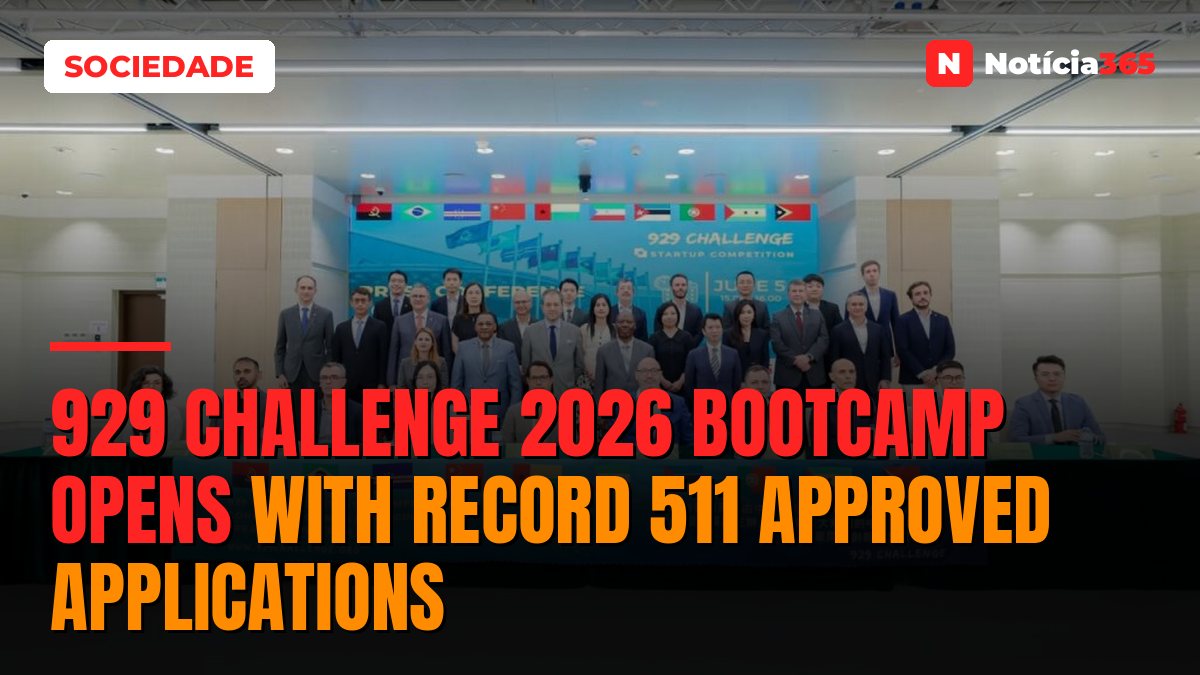

The 929 Challenge 2026 Bootcamp opened on Monday, 12 October, and runs through Friday, 16 October, with 511 approved applications — the highest number since the competition was founded. The intensive training and practical preparation programme brings together startups from Macau, the Greater Bay Area, mainland China, and Portuguese-speaking countries, with Brazil leading registrations with more than 100 projects.
According to the organisers, Brazil stands out this year as the primary source of applications, with more than 100 startups supported by the Brazilian Micro and Small Business Support Service (Sebrae) in promoting the initiative. "The record number of applications reflects the growing interest in connecting the innovation ecosystems of China and the Portuguese-speaking countries," the organisation said in a statement.
The organisers highlight growing interest in both directions: startups from Portuguese-speaking countries are seeking entry into the Chinese market, while Chinese companies are expressing interest in expanding into Lusophone markets. Health, financial technology (fintech), energy, and deep tech are among the featured sectors in this edition. The competition also includes projects in agricultural technology (agritech), biotechnology, artificial intelligence, and sustainability.

The Bootcamp aims to prepare teams for international expansion, addressing differences between markets — including digital tools, consumer habits, and business culture.
Miguel Pombo, founder of Azores Life Science and a finalist in the 2025 edition, opened the programme with an address on the impact of participating in the 929 Challenge on the development of his company.
The training includes three sessions dedicated to Macau, the Greater Bay Area, and China's digital economy, as well as presentations on the main Portuguese-speaking markets. Two further sessions focus on preparing teams for engagement with investors.
Rui Ferreira, executive vice-president of Golden Meridian VC, addresses the criteria investors use when evaluating startups. João Laginha Martins, head of platforms at The Venture Growth, leads a session on pitching projects to investors.
Sessions are held live online between 19:00 and 21:00 Beijing time, corresponding to 13:00 and 15:00 in Mozambique. Following the training phase, teams will move on to individual mentoring sessions.
Selection of 16 Finalists
The mentoring programme draws on a network of more than 100 investors, company founders, academics, and managers, who help teams refine their business models and identify priority markets for expansion.
Each team will subsequently be required to submit a project presentation video and a supporting pitch deck. A jury will evaluate the submissions and select 16 finalists.
The competition final and the 929 Summit are scheduled for 4 December in Macau, according to the statement. Finalists will have the opportunity to visit innovation centres in Macau, Hong Kong, Shenzhen, and Guangzhou, as well as meet with companies, investors, and government bodies linked to their respective sectors. "Our objective is to shorten the distance between entrepreneurs from Portuguese-speaking countries and China," said Marco Duarte Rizzolio, co-founder of the 929 Challenge and president of the Macau-China and Portuguese-Speaking Countries Entrepreneurship and Innovation Association (AEIMCP).
Rizzolio said the strong Brazilian participation demonstrates that entrepreneurs see Macau as a gateway to the Chinese market. He also acknowledged the support of the Macau Economic and Technological Development Bureau (DSEDT), the Macau Forum, and other partners.
The 929 Challenge is organised by the AEIMCP and co-organised by the Macau Forum and the Sino-Lusophone Association for Sustainability, with support from the DSEDT. Founded in 2021, the competition connects startups and university teams from China and Portuguese-speaking countries. The name represents the nine cities of the Greater Bay Area, the two Special Administrative Regions — Macau and Hong Kong — and the nine Portuguese-speaking countries, reinforcing Macau's role as a platform linking China with the Lusophone world.
Source: Diário Económico
Original article: https://www.diarioeconomico.co.mz/2026/10/12/trends/inovacao/929-challenge-arranca-com-recorde-de-511-candidaturas-aprovadas/