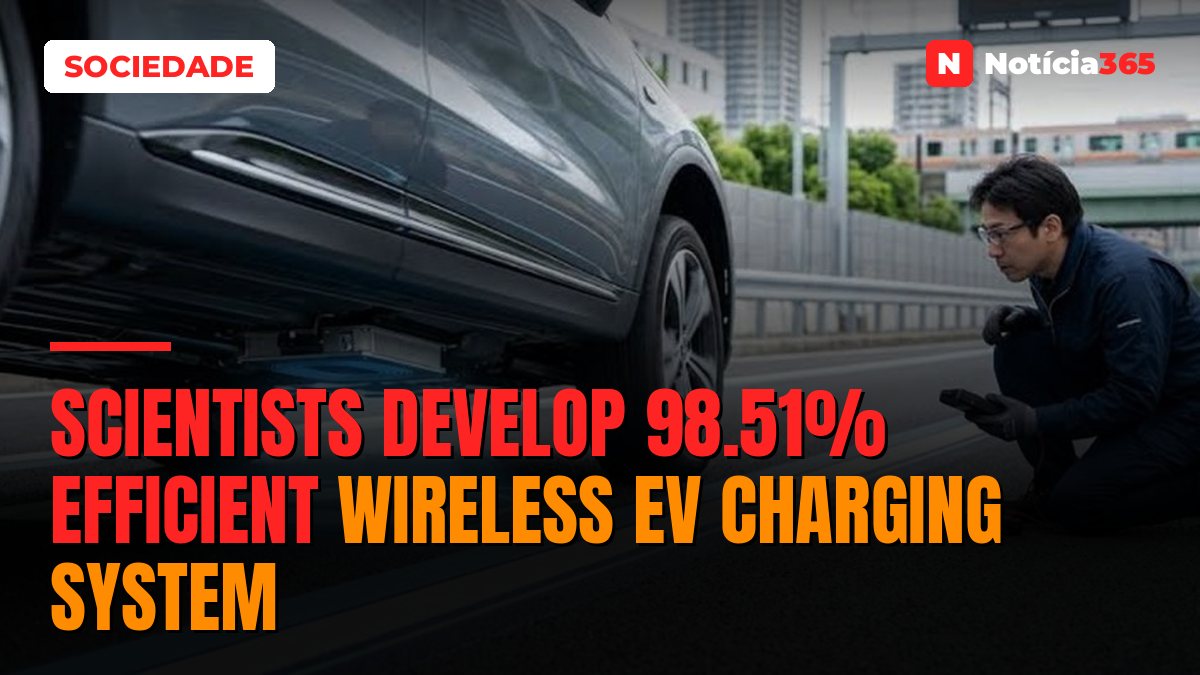

A team of Chinese and British researchers has developed a wireless charging system for electric vehicles capable of transferring power at 20 kilowatts (kW) while achieving an energy conversion efficiency of 98.51%. The technology could facilitate automated charging of autonomous vehicles, eliminating the need for a physical connection to a charger.
The system is the result of a collaboration between the Dongguan Institute of Materials and Technology in China's Guangdong province, the City University of Hong Kong, the University of Cambridge, and institutions affiliated with the Chinese Academy of Sciences.
The study, published in the scientific journal Nature Communications, presents a magnetic core structure produced from nanocrystalline alloys, designed to increase energy efficiency and power density while maintaining thermal stability during operation.
The solution uses a viaduct-type magnetic configuration, developed to meet the demands of high-power charging, including prolonged exposure to elevated temperatures.
The magnetic core measures 440 millimetres in length, 330 millimetres in width, and four millimetres in thickness. According to the researchers, the latter dimension is half the thickness of conventional ferrite-based solutions, allowing for a more compact structure capable of supporting higher power density.
Technology Could Facilitate Charging of Autonomous Vehicles
Inductive charging enables energy transfer between two components through a magnetic field, without the need for direct electrical contact.
This feature could prove particularly useful in autonomous vehicles, which require charging solutions capable of operating without human intervention.
Conventional systems based on ferrite cores present limitations related to power density and thermal behaviour. The use of nanocrystalline alloys aims to overcome these constraints, enabling the development of more compact and efficient equipment.
According to the Dongguan Institute of Materials and Technology, the technology could also be applied to railway transport, industrial automated guided vehicles, and aircraft designed for low-altitude operations.
The researchers intend to continue optimising system performance and evaluating the possibilities for industrial application.
The development comes at a time when China is seeking to accelerate innovation in electric and autonomous mobility. The Ministry of Industry and Information Technology and eight other government departments have announced a plan for the 2026–2030 period, which envisages expanding the use of intelligent and connected vehicles, including models with autonomous driving functions.
Source: Diário Económico
Original article: https://www.diarioeconomico.co.mz/?p=551495