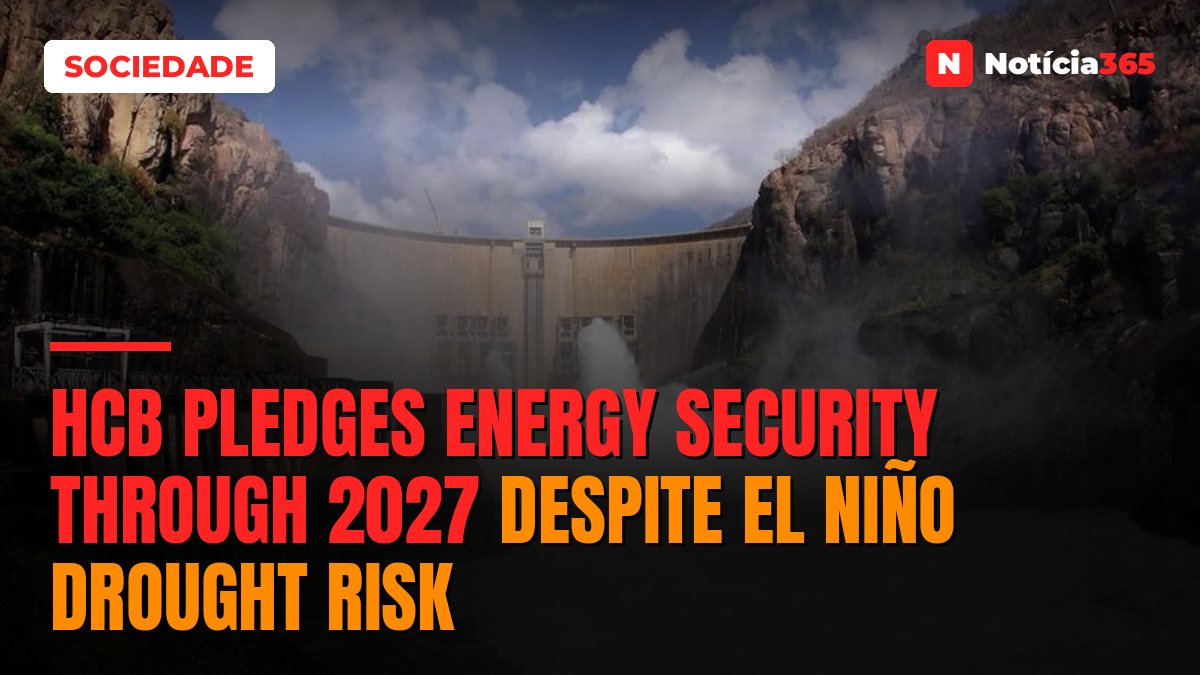

Hidroeléctrica de Cahora Bassa (HCB) has assured the continuity of electricity supply to Mozambique in 2026 and 2027, despite forecasts of drought conditions linked to the El Niño phenomenon, which is expected to reduce inflows into the dam during the next hydrological year, according to the Lusa news agency.
The assurance was given by HCB board chairman Tomás Matola at the Tete International Investment Conference, where he explained that the company is implementing a production strategy to manage water reserves and maintain energy supply to the domestic market and neighbouring countries.
According to Matola, the reservoir’s storage level reached 56% in May before falling to 52% at the end of the rainy season. The company projects the level will stand at approximately 50% in December and 30% by the end of 2027.
“For next year, in average terms, we estimate receiving inflows of 1,143 cubic metres and turbining 1,425 — meaning we will turbine slightly more than we receive,” he said, explaining that the management of stored water will allow production to be maintained at levels sufficient to meet national demand.
HCB Prepares Operations to Weather Drought
Meteorological forecasts point to a high probability of El Niño occurring in the 2026–2027 hydrological year, with below-normal precipitation and a consequent reduction in inflows across the Zambezi basin.
Faced with this scenario, HCB plans to operate in 2027 with an average of 4.25 generating units, capped at 150 megawatts of capacity, in order to control the drawdown of reserves and preserve water for subsequent years.
“This is the strategy that our calculations indicated would allow us to manage the storage level,” Matola said, adding that the dam is currently turbining less water than it receives.
He said the storage level projected for the end of 2027 would allow 2028 to begin with a safety margin, even in the absence of significant rainfall.
However, any reduction in output could affect electricity exports, revenues, and the company’s financial results — without, according to Matola, compromising domestic supply.
“From an energy security standpoint, 2026, 2027, and 2028 — we are comfortable,” he said.
Output Expected to Decline in 2027
For 2027, HCB estimates gross energy production of approximately 13,037 gigawatt-hours (GWh), below the slightly over 13,200 GWh projected for this year.
The company, which accounts for around 80% of electricity generated in Mozambique, produced 6.37 million megawatt-hours between January and June 2026.
In parallel, HCB is executing the rehabilitation of the Southern Power Station in a US$574.6 million investment, and is preparing to expand generation capacity through the Northern Power Station, which envisages three generating units and an installed capacity of 1,245 megawatts. The company also has a 400-megawatt solar photovoltaic project in the pipeline.
The National Meteorology Institute forecasts a strong El Niño event between November 2026 and April 2027, with below-average rainfall across the southern and central regions of the country — a scenario that could increase pressure on water resources and food security.
Source: Diário Económico
Original article: https://www.diarioeconomico.co.mz/2026/10/09/oilgas/energia/hcb-garante-seguranca-energetica-nacional-em-2026-e-2027-apesar-do-el-nino/